Catholic Wedding Seating: Pew Order, Reception, and Etiquette
 MySeatPlan
·
MySeatPlan
·
Catholic weddings have specific seating traditions for both the church ceremony and the reception. Here's the traditional pew order, where each family member sits, who gets reserved seating, and how it all translates to the reception hall.
Ready to create your own event seating chart?
Try our free drag-and-drop seating chart builder.
Get Started →A Catholic wedding has two distinct seating phases: the ceremony in the church, where pew order follows centuries-old traditions, and the reception, where the seating chart looks more like a typical wedding but still carries some Catholic-specific touches. Both matter, and getting the ceremony pew order right is one of the small details that signals to your family that you understood and honored the tradition.
This guide walks through Catholic wedding seating from start to finish: the church pew order, where each family member sits, the wedding party's position at the altar, and how the reception is typically arranged. It's written for couples planning a Catholic wedding (Nuptial Mass or ceremony-only) and acknowledges that customs vary between cultural communities within the Catholic tradition.
A Quick Note on Variance
Catholic wedding seating traditions are well-documented, but they're not uniform. Customs differ across Catholic communities: Italian, Irish, Polish, Hispanic, Filipino, Vietnamese, and other cultural backgrounds each layer their own traditions onto the basic Catholic structure. The pew order described here is the standard framework most American Catholic weddings follow, but always defer to your priest, your family, and your community's customs for specifics.
The Quick Reference
| Pew | Bride's side (left from guests' view) | Groom's side (right from guests' view) |
|---|---|---|
| First pew | Bride's parents (mother for sure, father if not escorting) | Groom's parents |
| Second pew | Grandparents, siblings not in the wedding party | Grandparents, siblings not in the wedding party |
| Third to fifth pews | Aunts, uncles, first cousins, godparents | Aunts, uncles, first cousins, godparents |
| Behind | Extended family, friends | Extended family, friends |
The bride's side traditionally sits on the left of the aisle (from the guests' view facing the altar), with the groom's side on the right. This convention extends from the wider Western Christian tradition. For more on which side the bride sits, see our atomic guide on should the bride sit on the left or the right.
The Pew Order
The pew order is the most distinctly Catholic part of the wedding seating. Unlike a reception, where you have flexibility, the church pews follow a clear convention designed to honor the immediate family with the closest seats.
The first pew (front row)
Reserved for the parents of the couple. Specifically:
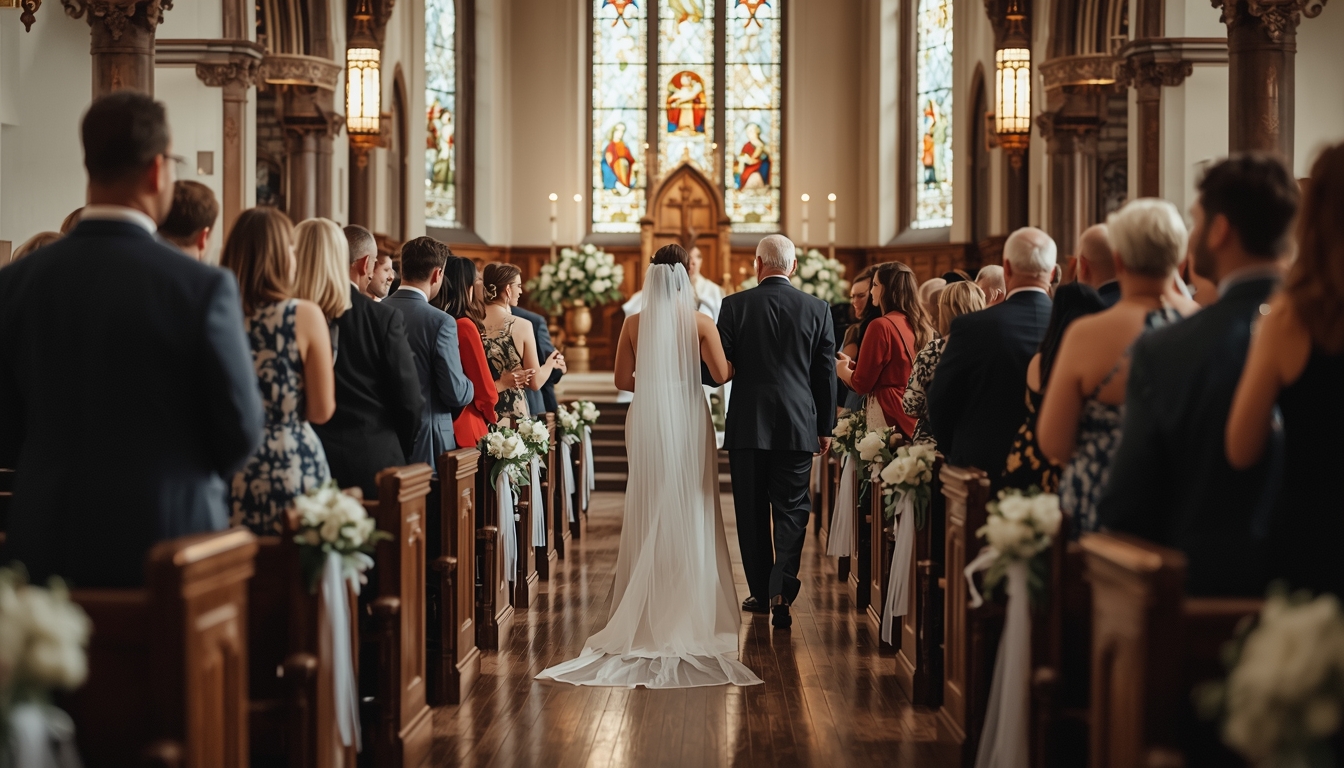
- Bride's side, first pew: the bride's mother sits closest to the aisle. If the bride's father is walking her down the aisle, he joins his wife in this pew after escorting the bride to the altar (this is sometimes done after the bride is "given away," though many modern Catholic weddings have shifted away from that wording). If the father isn't escorting, both parents are seated here at the start.
- Groom's side, first pew: the groom's parents, mother closest to the aisle.
If parents are divorced and remarried, the seating gets more nuanced. We cover that below.
The second pew
Grandparents and any siblings not in the wedding party sit here. Both sides follow the same pattern. Grandparents traditionally sit in the second pew rather than the first because the first is reserved for the parents who are hosting.
Third through fifth pews
Extended close family: aunts, uncles, first cousins, and godparents. Godparents (the bride's and groom's own godparents from baptism) traditionally have a place of honor and may be seated in the second or third pew at the family's discretion.
Beyond
The remaining pews fill with extended family, family friends, and other invited guests, with closer relationships seated further forward.
Reserved seating signage
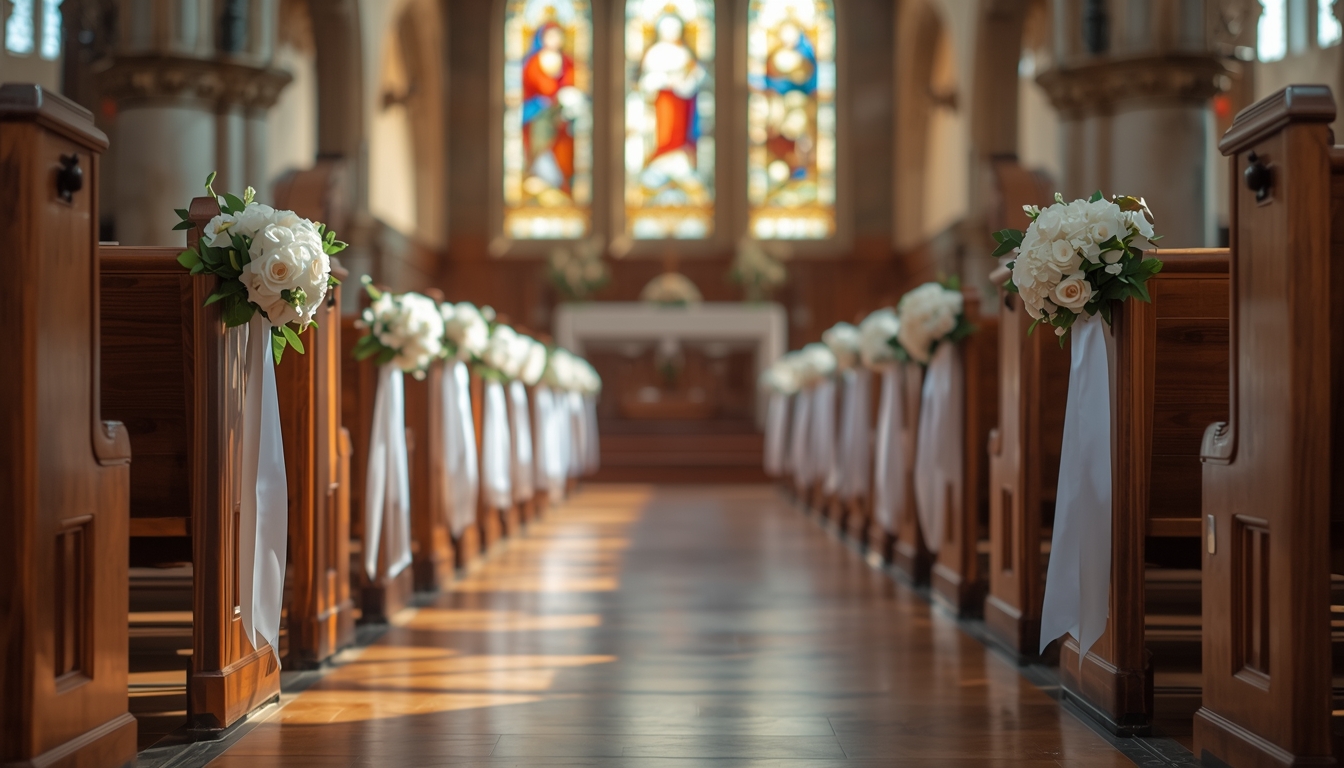
The first 2 to 4 pews on each side are typically marked with white satin ribbons, signs, or fresh flowers indicating "Reserved." Ushers know which pews are reserved and direct guests accordingly. Without these markers, guests will fill the front pews on their own and immediate family will arrive to find their spot taken.
"Bride's Side, Groom's Side" — Or Pick a Seat?
The traditional rule (bride's family on the left, groom's family on the right) is sometimes relaxed at modern Catholic weddings, especially when guest counts are uneven. If the bride's family has 80 guests and the groom's family has 25, strict side seating creates an unbalanced look in the church.
Two common modern approaches:
- Strict tradition. Each family on its assigned side, regardless of how unbalanced it looks.
- Pick a seat, not a side. A small sign at the church entrance invites guests to sit anywhere. This is increasingly common and removes the awkwardness of an empty groom's side.
If you go with "pick a seat, not a side," still reserve the first 2 to 4 pews on each side for immediate family. The relaxed seating applies only to extended family and friends.
The Wedding Party at the Altar
During the Catholic wedding ceremony, the wedding party stands at the altar (or just below it) rather than sitting in pews. The arrangement is:
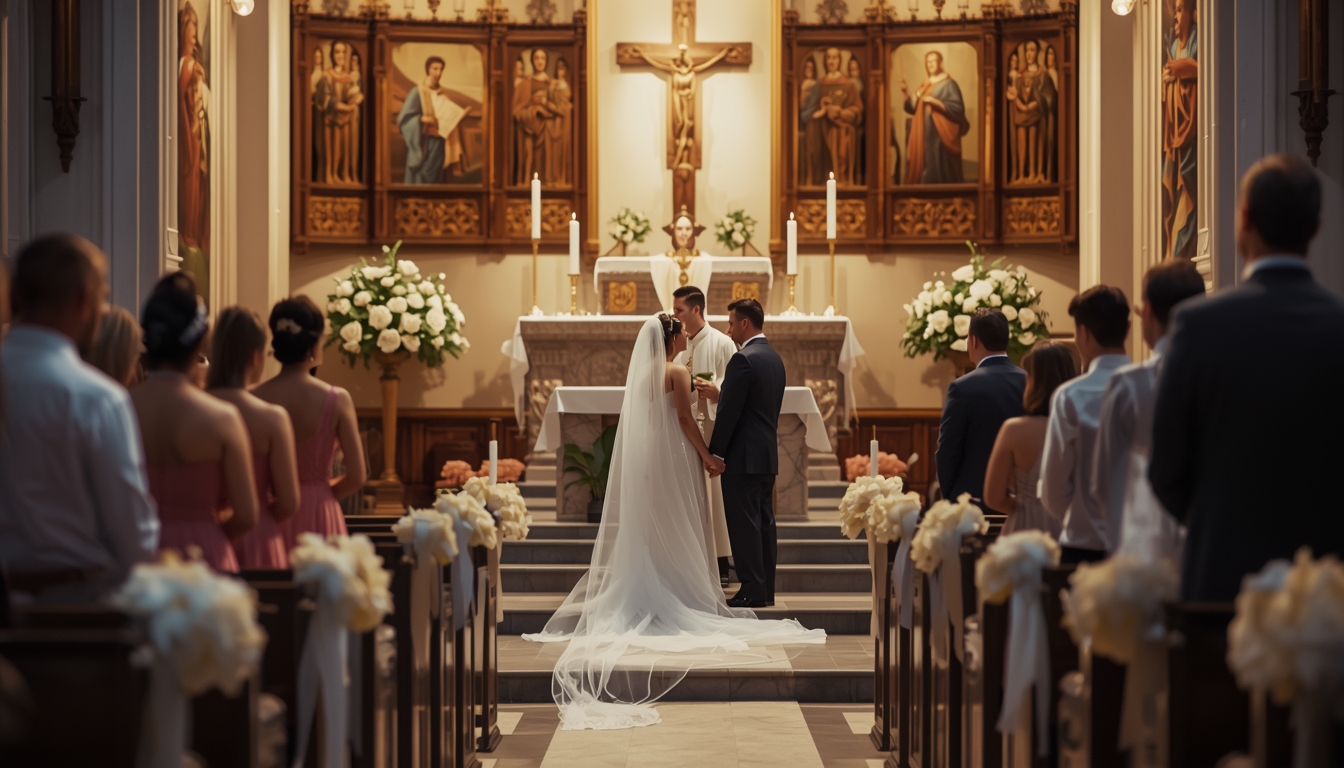
- Bride and groom in the center, facing the priest at the altar.
- Maid of honor next to the bride, on the bride's left.
- Best man next to the groom, on the groom's right.
- Bridesmaids and groomsmen arranged outward from the maid of honor and best man, alternating sides.
This parallels the ceremony positioning at non-Catholic Christian weddings. The maid of honor holds the bride's bouquet during key moments. The best man holds the rings.
For longer Nuptial Mass ceremonies (which can run 60 to 90 minutes), the wedding party may sit on chairs placed near the altar during portions of the Mass when the couple is also seated. Smaller chapels may not accommodate this; larger churches typically do.
Special Situations
Divorced parents
This is the trickiest area of Catholic ceremony seating. The traditional approach assumes both parents are married to each other, which is no longer always the case.
Common arrangements:
- If divorced parents are amicable: they can share the first pew, with a sibling, grandparent, or close family member as a buffer between them.
- If the divorce was difficult: the parent who primarily raised the bride or groom sits in the first pew. The other parent sits in the second pew with their current spouse, if remarried.
- If both parents are remarried: each biological parent sits with their current spouse, in separate pews. The biological parent's pew (first or second) reflects their relationship to the couple.
For deeper guidance on this, see our atomic guide on where divorced parents sit at a wedding and our full pillar piece on seating divorced parents at a wedding.
Stepparents
Stepparents who are part of the family attend with their spouse and sit in the same pew. If a stepparent helped raise the couple, they're often given a spot in the first pew alongside the biological parent. If the relationship is more distant, the second pew with the family is appropriate.
Second marriages
For couples on a second marriage, Catholic weddings can still follow the traditional pew order, but the arrangement may include adult children from previous marriages sitting in the front pews alongside the new spouses' parents. Ask your priest for guidance on the specific protocol if this applies.
Deceased parents
If a parent has passed away, their pew seat is sometimes left empty (with a single rose or candle in their place) as a symbolic gesture. The remaining parent sits as they normally would. This isn't a strict rule, just a thoughtful tradition some families choose.
The Reception
Catholic wedding receptions follow most of the same patterns as other Western receptions, with a few specific considerations.
Where the couple sits
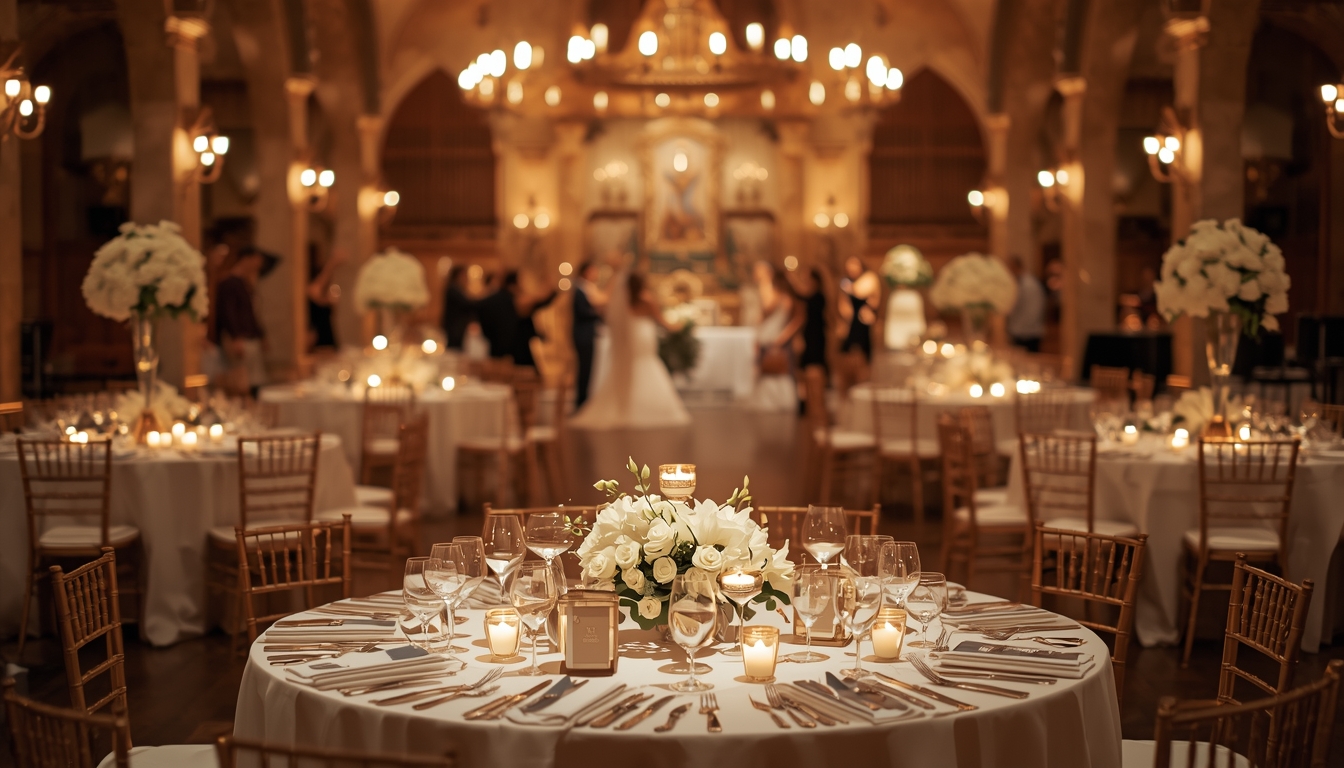
Most modern Catholic weddings use either a head table (with the wedding party) or a sweetheart table (just the couple). Both are acceptable; neither is more or less Catholic. For the comparison, see our pillar piece on head table vs sweetheart table.
The parents' table
Both sets of parents traditionally have a prominent reception table near the head or sweetheart table. This often includes:
- Bride's parents
- Groom's parents
- Grandparents
- The priest (if attending the reception)
- Sometimes the couple's godparents
For more on this table's composition, see our atomic guide on where does the officiant sit at a wedding reception.
Where the priest sits
If your officiating priest stays for the reception (some do, some leave after the ceremony), they're traditionally seated at the parents' table or a designated family-of-honor table. Their plus-one, if any, sits with them.
If the priest is a close family friend or relative, they may instead sit with that family group. If they're a parish priest you don't know personally, the parents' table is the standard placement.
An honorarium for the priest is typical, distinct from any church fee. Hand it to them privately before or after the ceremony, or via the best man during the cocktail hour.
Cultural Variations Within Catholic Weddings
Catholic weddings vary significantly by cultural community. A few common variations:
Hispanic Catholic weddings (lazo, arras, veil)
Hispanic and Latin American Catholic weddings often include the lazo (a cord or large rosary draped over the couple), the arras (13 coins exchanged between the couple), and a veil ceremony. These take place at the altar during the ceremony, performed by padrinos and madrinas (godparents of the wedding, distinct from baptismal godparents). Padrinos have honored seating at the reception, often at their own designated table or at the parents' table.
Filipino Catholic weddings
Filipino Catholic weddings have several roles for ninongs and ninangs (godparents of the wedding), including primary sponsors (who serve as witnesses and offer counsel) and secondary sponsors (who participate in the candle, veil, and cord ceremonies). Sponsors are seated at honored reception tables, sometimes a dedicated "sponsors' table."
Italian Catholic weddings
Italian Catholic weddings often include the confetti (sugared almonds in tulle bundles given to guests), the la busta (money envelopes from guests), and extended family sections at the reception. The mother of the bride and mother of the groom often have specific honor moments during the reception.
Polish, Irish, Vietnamese, and other Catholic communities
Each cultural Catholic tradition has its own variations. The core pew order described above generally holds, but reception customs (toasts, dances, blessings, cultural rituals) differ. Defer to family tradition.
If There's a Nuptial Mass vs. Just a Ceremony
Catholic weddings come in two formats:
- Nuptial Mass (full Mass with Communion). Runs 60 to 90 minutes. Guests are invited to participate in Communion (Catholic guests in good standing receive; others may come forward for a blessing or stay in their pew).
- Wedding ceremony without Mass. Shorter, typically 30 to 45 minutes. Common when one of the couple is not Catholic, or when the family wants a shorter service.
The pew order is the same for both. The main difference for guests is the length and the Communion portion. If many guests are not Catholic, your priest may opt for the shorter format to keep the ceremony accessible to everyone.
Common Mistakes
- Forgetting to mark reserved pews. Without ribbons or signs, the front rows fill with whoever arrives first, and immediate family arrives to find their spot taken.
- Not briefing the ushers. Ushers seat guests during the prelude. They need to know who's on each side and which pews are reserved.
- Skipping the second-pew grandparents placement. Grandparents are honored guests. Don't bury them in the third row.
- Mishandling divorced parents at the front pew. Default to separating them with a buffer. The exception, not the rule, is amicable parents who explicitly want to share a pew.
- Forgetting the priest at the reception. If they're staying, they get a real seat with their plus-one, not a chair pulled up to a corner. Place them at the parents' table or a family-of-honor table.
- Trying to do the pew order without help. Your priest, parish wedding coordinator, or a family member who's coordinated other Catholic weddings will catch issues you miss.
- Underestimating ceremony length. A Nuptial Mass with full music can run 90+ minutes. Plan the reception timeline accordingly so the gap between ceremony and reception isn't excessive.
The Reception Seating Chart
Once the ceremony is over, the reception seating follows the standard Western reception chart with the cultural and religious touches noted above. The biggest decisions are:
- Head table or sweetheart table for the couple
- Parents' table near the front
- Priest seated with the parents or family-of-honor table
- Wedding party either at the head table or distributed at guest tables
- Family hierarchy (grandparents, godparents, padrinos/ninongs) placed thoughtfully
- Friends and extended family in the middle and outer rings
For the full step-by-step process of building a reception seating chart, our step-by-step guide to creating a wedding seating chart walks through every step from final RSVPs to printed place cards. And for the broader etiquette principles, see our wedding seating chart etiquette guide.
Quick Reference: Catholic Wedding Seating Checklist
- Reserved-pew signs or ribbons placed on the first 2 to 4 pews on each side
- Bride's side on the left, groom's side on the right (from guests' view)
- Bride's parents in the first pew on the left
- Groom's parents in the first pew on the right
- Grandparents and immediate family in the second pew
- Godparents in second or third pew (placement varies by family)
- Divorced parents handled with appropriate buffer or separate pews
- Wedding party stands at the altar in the standard arrangement
- Priest seated at the parents' or family table at the reception, with plus-one
- Cultural variations (lazo, arras, sponsors, ninongs) honored where applicable
- Reception chart reviewed with both sets of parents before printing
Catholic wedding seating is one of the rare areas where tradition gives you a clear, well-tested template to work from. Mark the pews, brief the ushers, place the families with respect, and the church portion runs itself. From there, the reception is yours to design within whatever cultural traditions matter most to your families.
When you're ready to build the reception layout, MySeatPlan's drag-and-drop seating chart builder handles the parents' table, the head or sweetheart table, the family hierarchy, and everything in between visually. Start there, share it with your parents and your priest, and iterate before printing.
Frequently asked questions
-
The front pews are typically reserved for the couple’s parents, with the bride’s family on the left and the groom’s family on the right when facing the altar. Grandparents, siblings, godparents, and close family usually sit in the next reserved rows.
Plan your perfect event seating arrangement
MySeatPlan gives you everything you need to organize your big day — all in one place.
- Drag-and-drop seating chart
- Guest list with RSVP tracking
- Export seating charts as images & PDF
- Share your plan with others via shareable link
- Design your invitation card
- Guest photo & video uploads