The Complete Wedding Planning Timeline: Month by Month
 MySeatPlan
·
MySeatPlan
·
Wedding planning feels overwhelming until you break it into a month-by-month timeline. Here's exactly what to do, and when, from the day you get engaged to the morning of your wedding.

Ready to create your own event seating chart?
Try our free drag-and-drop seating chart builder.
Get Started →Wedding planning is not hard because the individual tasks are hard. It's hard because there are so many of them, and they all have to happen in the right order. Book the venue before you send save-the-dates. Send save-the-dates before you finalize the guest list. Finalize the guest list before you build the seating chart. Miss the order and you'll redo work, lose deposits, or run out of time.
This is the full wedding planning timeline, laid out month by month. Use it as a running checklist from the week you get engaged to the morning of the wedding. Every bullet point below has been ordered so that whatever comes next depends on what came before it, not the other way around.
Before You Start: The Three Big Decisions
Before any timeline starts, you and your partner need to align on three things. Without these, every downstream decision is guesswork.
- Budget. A real number, not "we'll figure it out." Include a 10% buffer for overruns (there will be overruns).
- Rough guest count. Not the final list, just the ballpark. 60, 120, or 200 guests lead to completely different venues and budgets. Our guide on how many people to invite to your wedding walks through the math.
- Season and general location. Spring or fall, local or destination, city or countryside. You don't need an exact date, just a window.
Once those three are settled, the timeline begins.
12+ Months Before: The Foundation
This is the longest and least stressful stretch of planning, and that's deliberate. Everything you do in the first three months locks in the big, expensive commitments that the rest of the plan depends on.
- Set the official budget and decide who's contributing.
- Draft the full guest list, with both families aligned on roughly how many people each side gets.
- Research and tour venues. Book the venue first, then set the date.
- Book the officiant if it's someone you need to travel or reserve early.
- Hire a wedding planner or day-of coordinator, if you're using one.
- Start a shared wedding folder (cloud drive) for contracts, inspiration, and guest info.
- Begin research on photographers, videographers, and the big-ticket vendors who book out 9 to 12 months ahead.
The venue is the single most important early decision because it determines your date, your guest capacity, and a large share of your budget in one contract.

12 to 10 Months Before: Lock the Big Vendors
Once the venue is booked and the date is set, the dominoes start falling. Top-tier vendors book out far in advance, especially for peak-season weddings (May to October in most regions).
- Book the photographer and videographer.
- Book the caterer (if not included with the venue).
- Book the band, DJ, or ceremony musicians.
- Book the florist.
- Send save-the-dates, especially if guests need to travel.
- Shop for wedding attire. Wedding dresses often take 4 to 6 months to order and alter.
- Build a wedding website with travel and accommodation info.
Save-the-dates are not invitations. They're a heads-up so guests can request time off, book flights, and hold the date. Send them to everyone you definitely plan to invite, but not to people you're unsure about (adding guests is easier than un-inviting them).
9 to 7 Months Before: Fill In the Middle Layer
The big bookings are done. Now it's time for the mid-tier decisions that build out the day.
- Book transportation for the wedding party and guests (shuttles if needed).
- Reserve a hotel block or preferred rates for out-of-town guests.
- Book the baker for the cake and any dessert stations.
- Finalize the wedding party (bridesmaids, groomsmen, ring bearers, flower kids).
- Book rehearsal dinner venue.
- Start planning the honeymoon. Book flights and any high-demand accommodations.
- Schedule engagement photos, if you want them for save-the-dates or the wedding website.
- Order bridesmaids' dresses and groomsmen's suits.
This is also the stage to start thinking about the reception format. Cocktail-style, plated dinner, buffet, family-style? The format affects floor plan, rentals, and timeline on the day. Our guide to wedding reception floor plan ideas breaks down the options for different venue sizes.
6 to 4 Months Before: The Details Take Shape
You're past the halfway point. The day is starting to feel real, and the detail work begins.
- Order wedding invitations. Plan to send them 6 to 8 weeks before the wedding.
- Register for gifts.
- Book the honeymoon fully.
- Purchase wedding rings.
- Finalize the menu with the caterer, including vegetarian, vegan, and allergy options.
- Plan the ceremony order and readings.
- Order or plan any rentals the venue doesn't provide (linens, chairs, lounge furniture, arbor).
- Book hair and makeup trials.
- Arrange any pre-wedding events: engagement party, bridal shower, bachelor/bachelorette trips.

3 Months Before: The Heavy Middle
This is the single busiest month for most couples because the detail work hits at the same time.
- Mail invitations with an RSVP deadline set 4 to 6 weeks before the wedding.
- Finalize the ceremony script with the officiant.
- Confirm vendor contracts, arrival times, and meal counts.
- Dress fitting #1.
- Write vows if you're doing personal ones.
- Plan day-of timeline with the planner or venue coordinator.
- Finalize rehearsal dinner guest list and invitations.
- Apply for a marriage license (check your local jurisdiction, some require it within a specific window).
If you haven't started a guest tracking system, do it now. A simple spreadsheet is fine, but something like our wedding guest list template will save you hours as RSVPs trickle in, meal choices come back, and plus-ones get added.
2 Months to 1 Month Before: Seating, Logistics, and Final Numbers
Once RSVPs start coming back, the seating chart becomes the biggest project. It's also the most iterative, because every late RSVP, every "my partner can now come," every "we have to bring our toddler" changes the layout.
- RSVP deadline closes. Chase outstanding responses by phone or text, don't rely on email.
- Build the seating chart. Account for family dynamics, plus-ones, and kids' tables. Our step-by-step seating chart guide walks through the exact order of operations.
- Confirm final headcount with the caterer and venue.
- Dress fitting #2 (or final).
- Write and send rehearsal dinner invitations.
- Finalize ceremony order, processional, and recessional.
- Assign day-of responsibilities: who holds the rings, who reads, who signs the marriage license.
- Confirm hair and makeup schedule for the morning.
- Order place cards, escort cards, menu cards, and signage. Our guide to writing wedding place cards covers name formatting and placement.
- Purchase or prepare wedding favors.
- Break in wedding shoes (wear them around the house for a few hours each weekend).
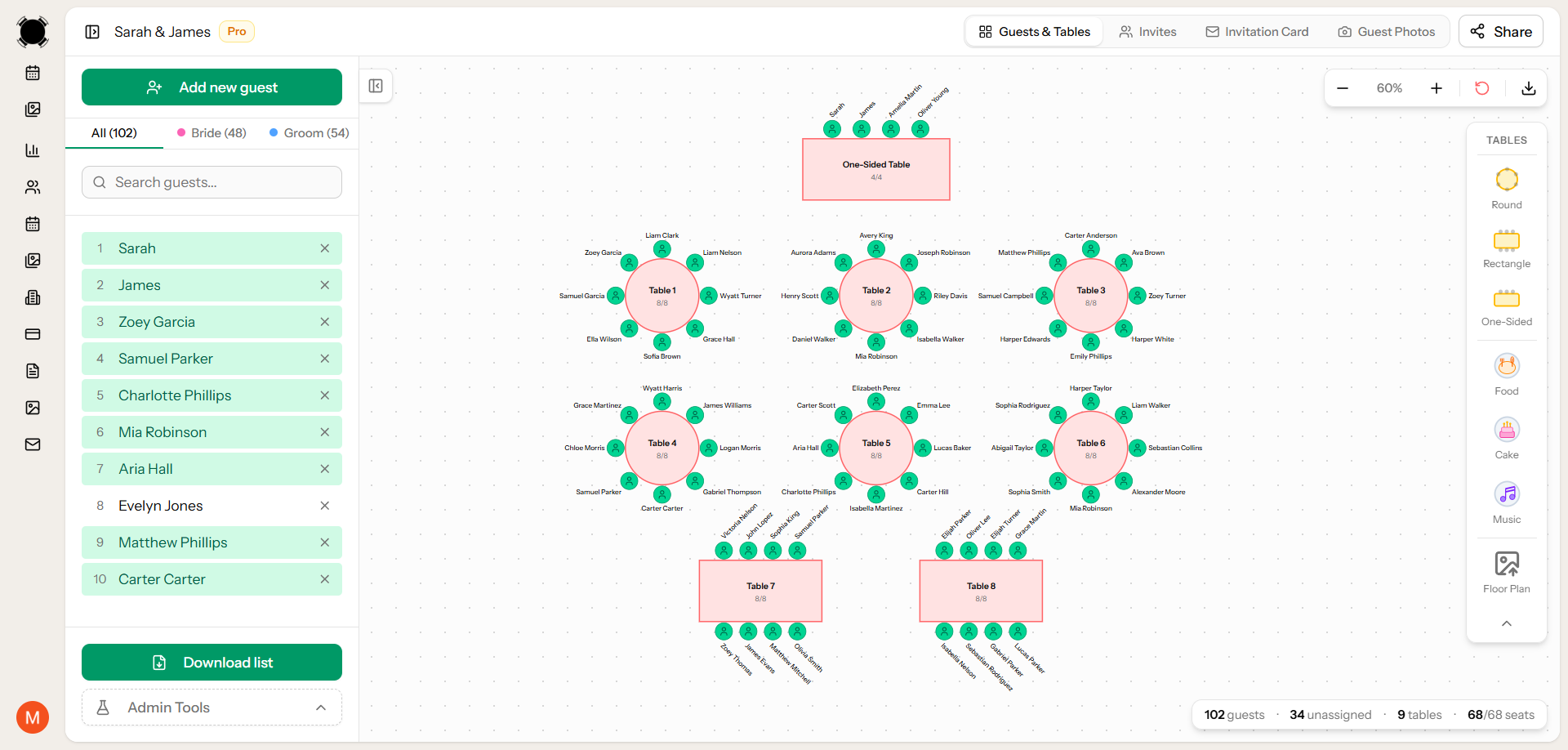
The seating chart is the single biggest reason couples wish they'd started earlier. It's not the writing that takes time, it's the conversations, the revisions, and the late RSVPs. MySeatPlan's drag-and-drop seating chart builder lets you move guests around visually as RSVPs come in, flag conflicts, and export a clean chart for the venue and place-card writer. It's the tool we built specifically for this phase, because a spreadsheet seating chart will drive you mad.
2 Weeks Before: Tightening Everything
The heavy planning is done. Now it's about confirming, double-checking, and getting yourself and your people ready.
- Give final headcount and meal counts to the caterer.
- Give the final seating chart to the venue, the coordinator, and the place-card writer.
- Confirm vendor timelines, addresses, and contact numbers.
- Pick up the marriage license (if required in your region).
- Write thank-you notes for pre-wedding gifts so you don't fall behind later.
- Pack for the honeymoon.
- Prepare tip envelopes for vendors who are traditionally tipped (officiant, musicians, hair/makeup).
- Delegate day-of roles to trusted people: emergency contact, vendor point person, gift and card collector.
- Rehearse vows out loud.
1 Week Before: The Home Stretch
- Final dress fitting, pick up the dress.
- Confirm all vendor arrival times in writing.
- Drop off welcome bags at the hotel for out-of-town guests.
- Pack an emergency kit: safety pins, stain remover, tissues, pain reliever, snacks, phone charger.
- Write checks or prepare digital payments for final balances.
- Get a good night's sleep every night. You'll need it.
- Confirm the rehearsal dinner timing and seating with everyone attending.
The Day Before: Rehearsal and Reset
- Rehearse the ceremony with the officiant, wedding party, and anyone with a role.
- Host the rehearsal dinner.
- Deliver any personal items to the venue: champagne, vow books, keepsake items.
- Hand off responsibilities to your day-of coordinator or trusted friend.
- Eat a real meal.
- Set multiple alarms.
- Sleep.
The Wedding Day: You're Not in Charge Anymore
The most important rule for the wedding day itself: you are not the project manager today. Your coordinator, planner, or designated friend is. Your only job is to get married and be present.
A realistic day-of timeline starts 6 to 8 hours before the ceremony (hair, makeup, getting dressed, photos) and runs through the reception into the send-off. For the evening hour by hour, our wedding reception timeline guide breaks down exactly what happens from cocktail hour to the last dance.
The Week After: Wrapping Up
- Return rentals (suits, décor, dress if you rented).
- Preserve the bouquet if you planned to.
- Send thank-you notes. Aim for within 1 to 2 months of the wedding.
- Submit any name-change paperwork, if you're changing names.
- Review and sign off on vendor final deliverables (photos, video).
- Leave reviews for vendors you loved.
Quick Reference: The 7 Most Time-Sensitive Tasks
| Task | When |
|---|---|
| Book venue | 12+ months before |
| Book photographer, caterer, band | 10 to 12 months before |
| Send save-the-dates | 8 to 10 months before |
| Order wedding dress | 8 to 10 months before |
| Send invitations | 6 to 8 weeks before |
| Finalize seating chart | 2 to 3 weeks before |
| Confirm headcount with caterer | 1 to 2 weeks before |
Common Timeline Mistakes to Avoid
- Sending save-the-dates before booking the venue. If the venue falls through, the date falls through.
- Waiting on big vendors. Top photographers and caterers book 12+ months out in peak season. Waiting until 6 months before means picking from leftovers.
- Starting the seating chart too late. Two weeks is not enough. Start as soon as RSVPs come in.
- Not setting an RSVP deadline. Guests will reply on the day of your wedding if you let them. Set a firm deadline 4 to 6 weeks before, and chase stragglers by phone.
- Overpacking the final week. If dress fittings, tastings, and errands all stack up in the last 7 days, you'll be exhausted by Thursday. Space them out.
- Trying to run the day yourself. Even on a small wedding, have one person whose job is "handle whatever comes up." It is not you.
If You Have Less Than 12 Months
Short engagements are not a disaster. They just require ruthless prioritization.
| If you have... | Focus on |
|---|---|
| 9 months | Venue first, then photographer and caterer. Skip to 12-month list, compress other tasks proportionally. |
| 6 months | Smaller guest list, off-peak date, flexible venue options. Prioritize venue, caterer, photographer in the first 2 weeks. |
| 3 months | Micro wedding (under 50 guests) or intimate venue. Hire a day-of coordinator immediately. |
| 1 month | Courthouse ceremony plus a dinner. Elopement with photographer. Celebration party later. |
A great wedding is not about how long you planned, it's about whether the right pieces got locked in at the right time. A 4-month planning window with a clear venue, a solid caterer, a good photographer, and a thoughtful seating chart will always beat a 2-year window that waited too long on the big decisions.
Final Thought
Wedding planning rewards structure, not perfection. If you follow the order of operations in this timeline (big commitments first, details later, seating chart after RSVPs close, day-of handed to someone else), the whole thing is manageable. Not easy, but manageable.
Save this page. Check off the tasks as you go. And when the seating chart phase hits in month 11 or month 12, you'll know exactly where to start.
Frequently asked questions
-
A typical wedding planning timeline spans 12 to 18 months, starting with budgeting and venue booking, followed by vendor hiring, invitations, and final details. The last 1–2 months focus on RSVPs, seating charts, and confirming logistics with vendors.
Plan your perfect event seating arrangement
MySeatPlan gives you everything you need to organize your big day — all in one place.
- Drag-and-drop seating chart
- Guest list with RSVP tracking
- Export seating charts as images & PDF
- Share your plan with others via shareable link
- Design your invitation card
- Guest photo & video uploads