Mexican Wedding Reception Traditions and Seating
 MySeatPlan
·
MySeatPlan
·
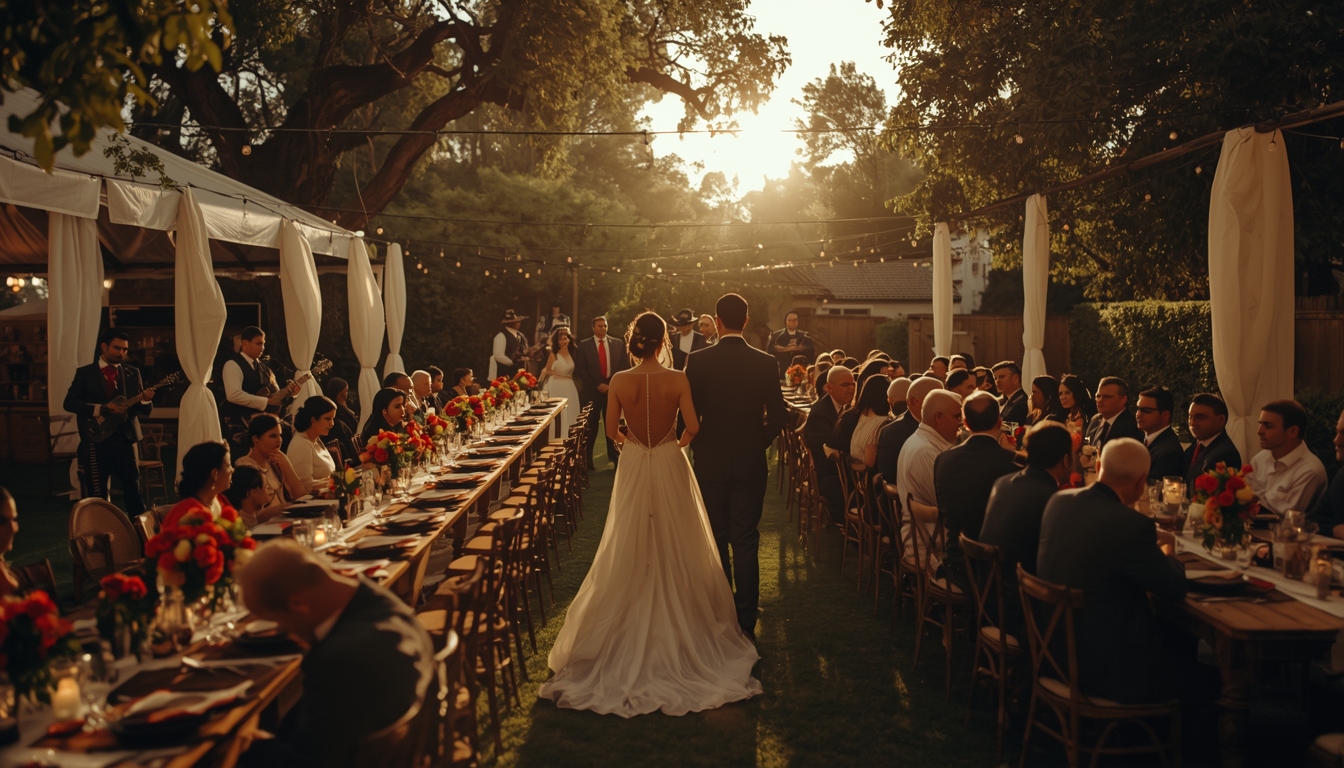
Mexican weddings are layered with traditions that shape the seating chart: the padrinos system, family hierarchy, the mariachi, and the late-night Hora Loca. Here's how the reception comes together and where each guest fits.
Ready to create your own event seating chart?
Try our free drag-and-drop seating chart builder.
Get Started →A Mexican wedding is a celebration that bridges religious tradition, family hierarchy, and a deep cultural commitment to honoring the people who shape your life. The seating chart reflects all of it. From the padrinos and madrinas (wedding sponsors) who guide specific moments of the ceremony, to the extended family that fills the reception, to the mariachi placement and the late-night Hora Loca, every part of the seating layout has roots in tradition.
This guide walks through how Mexican wedding seating typically works at the ceremony and reception, with particular attention to the padrinos system, family hierarchy, and the reception traditions that shape the layout. It's written for couples planning a Mexican or Mexican-American wedding and acknowledges that customs vary significantly across regions, communities, and modern adaptations.
A Note on Variance
"Mexican wedding" covers a wide range of regional and cultural variations. Northern Mexican (norteño / charro) traditions differ from Central Mexican (CDMX, Puebla, Guadalajara) traditions, which differ from Southern Mexican (Oaxaca, Chiapas) traditions with their stronger indigenous influences. US Mexican-American weddings often blend traditions across all of these.
This guide covers patterns common to most modern Mexican weddings, especially the padrinos system and reception layout. Always defer to your priest, your family elders, and your specific community's customs for the final decisions.
The Quick Overview
| Element | Where it sits |
|---|---|
| Couple's table or stage | Front of the room, facing all guests |
| Padrinos and madrinas | At their own honored table or distributed at family tables |
| Bride's and groom's parents | Adjacent to the couple's table |
| Grandparents and senior elders | Near the front, with parents |
| Bride's family tables | One side of the room |
| Groom's family tables | Opposite side of the room |
| Friends and extended guests | Middle and outer rings |
The Padrinos and Madrinas System
The padrinos (godfathers / male wedding sponsors) and madrinas (godmothers / female wedding sponsors) are the most distinctive feature of Mexican wedding seating. They're not the same as the wedding party in a Western sense, and they're not the same as the couple's baptismal godparents (though sometimes they're the same people).
Padrinos and madrinas are couples (or sometimes individuals) who sponsor specific elements of the wedding: financially contributing, spiritually supporting, or both. Each pair is associated with one ritual or item. Common roles include:
- Padrinos de velación — sponsors of the marriage itself, often the most senior pair, typically related family or close family friends
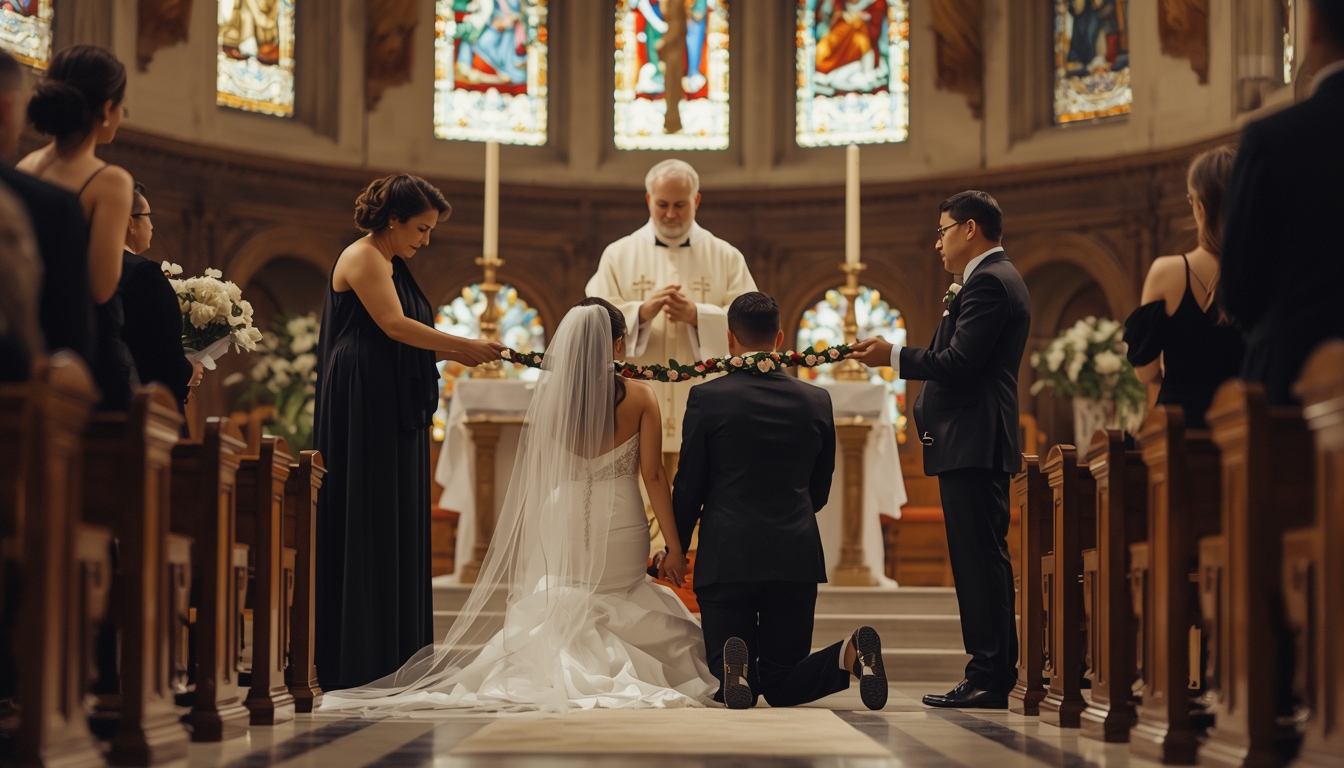
- Padrinos del lazo — sponsors of the lazo, the figure-eight cord placed around the couple during the ceremony
- Padrinos de las arras — sponsors of the 13 coins (arras matrimoniales) the groom presents to the bride
- Padrinos de los anillos — sponsors of the rings
- Padrinos del pastel — sponsors of the wedding cake
- Padrinos del ramo — sponsors of the bouquet
- Padrinos del champán / del brindis — sponsors of the champagne toast
- Padrinos de la Biblia y el rosario — sponsors of the Bible and rosary, where applicable
- Padrinos del cojín — sponsors of the kneeling pillow
A traditional Mexican wedding may have 5 to 12 pairs of padrinos and madrinas. Each pair has a real role: they participate in the ceremony, they often contribute financially to "their" element, and they're publicly honored throughout the day.
Where padrinos sit at the ceremony
During the Catholic ceremony, the padrinos del velación (the most senior pair) often sit in the first or second pew on either side of the aisle, sometimes with their own designated reserved seats. Other padrinos sit in nearby reserved pews, with their specific role's pair seated near the location of their ritual moment (so padrinos del lazo near the altar, for example).
For the broader Catholic ceremony pew order, see our guide on Catholic wedding seating: pew order, reception, and etiquette, which covers the standard Catholic ceremony layout that Mexican weddings build upon.
Where padrinos sit at the reception
You have two options for padrinos reception seating:
Option 1: A dedicated padrinos table
All the padrinos and madrinas sit together at one or two designated "padrinos tables" near the front of the room, adjacent to the couple's table or family tables. This honors them publicly and visually, and signals their importance to all guests.
Pros: Clear public honor, easy for guests to identify the padrinos, nice photo opportunity
Cons: Padrinos may not all know each other well, especially across the bride's and groom's sides
Option 2: Padrinos distributed at family tables
Each pair of padrinos sits with the family they're closest to (often the family of the bride or groom who chose them, or the family they're already related to). They're still honored individually but not as a separate group.
Pros: Padrinos sit with people they know; integrates them into family conversations
Cons: Less visible as a group; may dilute the public honor
The "right" choice depends on how connected the padrinos are to each other and how prominent you want their group identity to be. Most modern Mexican weddings use Option 2 for relatives and Option 1 for non-family padrinos who only know the couple.
The Ceremony Seating
Most Mexican weddings include a Catholic ceremony, with the standard Catholic pew order: bride's family on the left, groom's family on the right (from guests' view facing the altar), parents in the first pew, grandparents in the second.
What's distinct about Mexican Catholic weddings is the heavier inclusion of padrinos and the cultural rituals layered into the ceremony itself: the lazo, arras, and sometimes the velo (veiling). For the foundational Catholic seating structure, see the Catholic wedding seating guide. For divorced parent considerations, our atomic guide on where divorced parents sit at a wedding covers the etiquette.
The Reception Layout
The couple's table
Mexican wedding receptions vary in how they seat the couple:
- Sweetheart table. Just the couple at a small table at the front. Increasingly common at modern Mexican weddings. See our atomic guide on who sits at the sweetheart table.
- Head table with the wedding party. The couple plus damas (bridesmaids) and chambelanes (groomsmen) at a long table. Less common today but still used at more traditional weddings.
- Family head table. The couple at the center with both sets of parents flanking them, sometimes including grandparents. Common at more traditional Mexican weddings.
For the comparison between the first two options, see head table vs sweetheart table.
The parents' table
If the couple uses a sweetheart table, parents typically have their own designated table immediately adjacent. This includes:
- Bride's parents
- Groom's parents
- Grandparents (if attending and not at the head table)
- The priest (if attending the reception, which Mexican Catholic priests sometimes do)
- Sometimes the most senior padrinos del velación
Many Mexican weddings combine the bride's and groom's parents at one table to symbolize the union of the families. Others give each set of parents their own table on opposite sides of the couple. Both work; the choice depends on family preference and how well the two sets of parents get along.
Family hierarchy zones
Beyond the couple's and parents' tables, the rest of the room follows Mexican wedding hierarchy:
- Tier 1: Padrinos del velación and the most senior padrinos, plus immediate aunts and uncles
- Tier 2: Other padrinos, godparents, family elders
- Tier 3: Aunts, uncles, godfathers/godmothers from baptism, close family friends
- Tier 4: Cousins, family friends
- Tier 5: Friends of the bride and groom
- Tier 6: Colleagues, distant relatives, and acquaintances
The bride's family tables typically sit on one side of the room, the groom's family on the other, with shared friends, the wedding party, and combined-family connections in the middle.
Mariachi and Music Placement
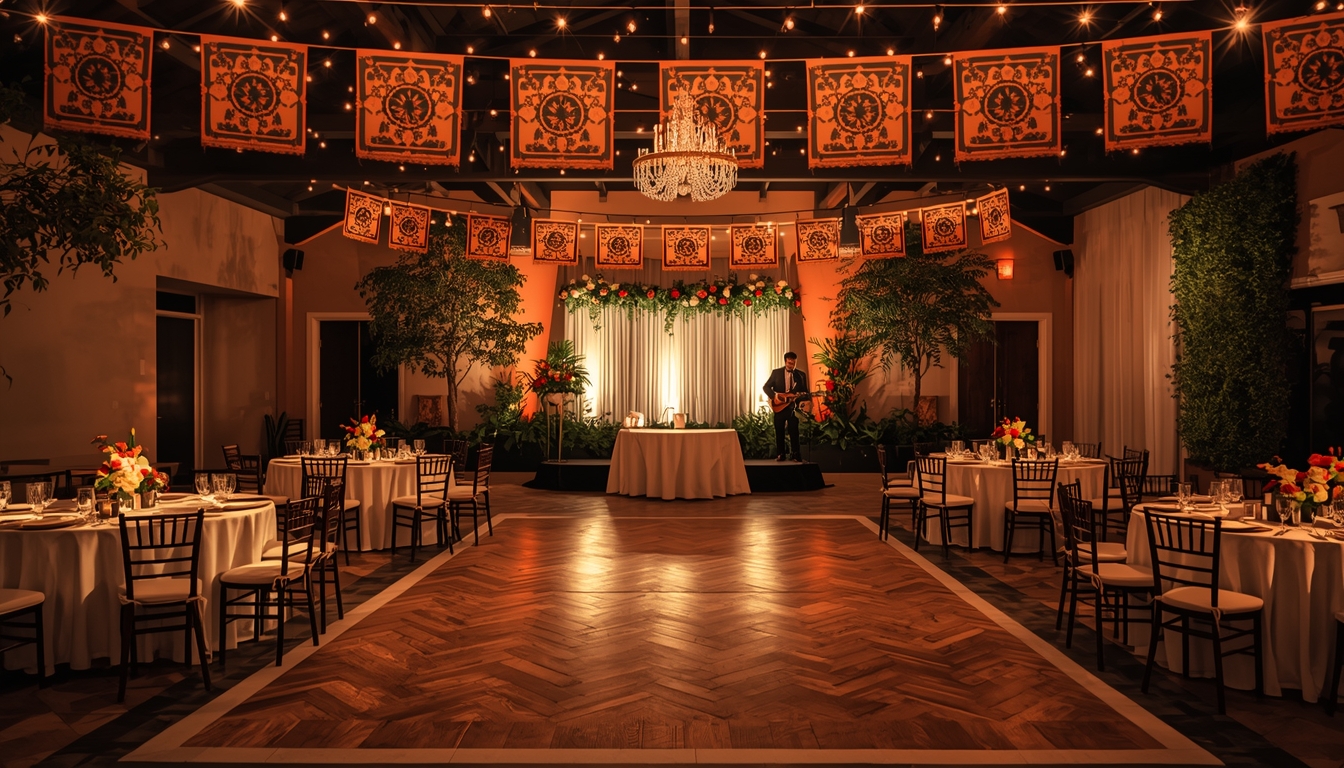
Most Mexican weddings include mariachi at some point, whether during the ceremony, the reception entrance, the toast, or a dedicated set during dinner. Mariachi placement affects the layout:
- If mariachi performs during the reception entrance: they need a clear staging area near the entrance, typically just inside the room.
- If mariachi plays a set during dinner: they need a small performance area near the dance floor or at the front of the room, with line-of-sight to the couple.
- If mariachi accompanies the toast: they're stationed near the head or sweetheart table during the brindis (toast).
Some weddings have a mariachi set early and a DJ or band for the rest of the night. Others have mariachi stationed for the whole event. Confirm with the venue that there's enough space for the mariachi (typically 6 to 12 musicians) plus their movement, and place the closest tables thoughtfully so guests aren't deafened during the set.
Reception Traditions That Affect the Layout
The first dance and parent dances
The first dance (often called el vals, the waltz) is traditionally a slow vals between the couple, sometimes joined later by parents and padrinos in a sequenced choreography. The dance floor needs to be visible from all family tables and accessible from the head or sweetheart table.
La Víbora de la Mar (the money dance)
A traditional Mexican wedding dance where guests form a chain holding hands, weaving through the dance floor under the bride's veil, while singing a traditional song. Some couples include it; many modern couples skip it. If you're including it, the dance floor and surrounding tables need to accommodate the chain's flow.
El Brindis (the toast)
The champagne toast typically happens before or during dinner. The padrinos del champán / del brindis often lead the toast, alongside the parents. Speakers should be seated near the head or sweetheart table for easy access to the microphone.
La Hora Loca (the crazy hour)
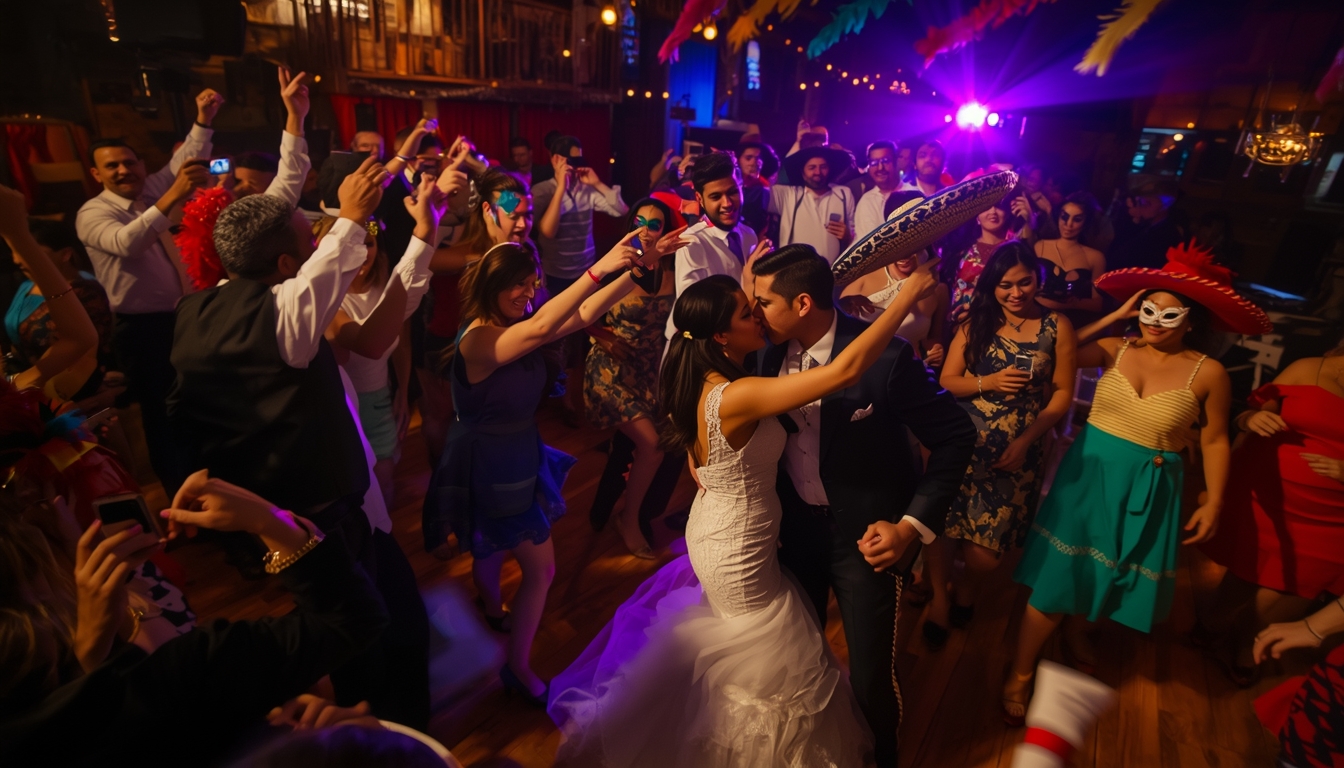
The Hora Loca is a late-night party hour, typically 1 to 2 hours into the dancing, where the music shifts to high-energy, the lights drop, and guests are given party props (sombreros, masks, feather boas, glow sticks, lighted bracelets). It's pure celebration and requires:
- An open dance floor large enough for most of the room to participate
- Tables placed with enough room for guests to leave and return easily
- A station (often near the dance floor) where the props are distributed
If you're doing La Hora Loca, factor it into the floor plan from the start. Tables crowded too close to the dance floor will create chaos.
The cake cutting
The pastel (wedding cake) is often elaborate and may be displayed prominently throughout the reception. The padrinos del pastel may be involved in the cutting ceremony. Plan a cake table location that's visible from the head and family tables, with space for photography during the cut.
Damas and Chambelanes
The wedding party in a Mexican wedding consists of damas (bridesmaids) and chambelanes (groomsmen). Their seating depends on the format:
- If using a traditional head table: damas and chambelanes sit at the head table with the couple.
- If using a sweetheart table: they sit at regular guest tables, often together at one or two designated "wedding party tables" placed close to the couple.
- If they have plus-ones: partners sit with them, either at the same table or at a "wedding party plus-ones" table nearby.
For more on wedding party sizing, see our atomic guide on how many bridesmaids and groomsmen should you have.
Special Considerations
Large guest counts
Mexican weddings often have very large guest lists, with extended family, padrinos, and family friends pushing total attendance to 200 to 500+. This means:
- Round tables of 8 to 10 throughout
- Multiple bar stations (especially given a typical Mexican wedding's multi-hour duration)
- Buffet or family-style service for very large counts; plated dinner for mid-sized weddings
- Clear signage so guests can find their tables
- A dedicated coordinator or coordination team
Recuerdos (wedding favors)
Recuerdos are traditional wedding favors given to each guest, often handcrafted and personalized. They're typically placed at each guest's seat or distributed at the entrance. Factor them into your seating chart timeline (they need to be at the place setting before guests arrive).
Children and family inclusion
Mexican weddings strongly include extended family, and that often includes children. A dedicated kids' area, a kids' table, or thoughtful seating with parents all work, depending on numbers. Our atomic guide on should kids have their own table at a wedding covers when each option works best.
Plus-ones
Mexican weddings tend to be generous with plus-ones, especially for unmarried adult guests. Be consistent in the policy. Our atomic guide on is it rude not to give plus ones at a wedding covers the etiquette.
Common Mistakes
- Treating the padrinos as a vague honorary group. Each pair has a specific role and deserves specific honor. Confirm their roles, brief them on the ceremony, and seat them with intention.
- Placing all padrinos at one back table. They should be near the front, visible, and treated as guests of honor.
- Forgetting the parents and padrinos in the same table cluster. The family-of-honor zone (parents + grandparents + senior padrinos) should sit together near the front.
- Underestimating the dance floor size. La Víbora de la Mar, La Hora Loca, and the long dance portion all need significant open space. Don't crowd the dance floor with extra tables.
- Putting elderly guests near the mariachi or DJ. Mariachi at full volume in a small space is loud. Keep older guests away from the speakers.
- Forgetting to brief the priest on his reception seat. If he's attending, the parents' table or family-of-honor table is appropriate. Send him an invitation with his table assignment.
- Skipping the seating chart at large weddings. Mexican weddings of 300+ without a seating chart create entrance chaos and uneven tables.
- Not consulting both sets of parents. Mexican wedding seating is a family decision. Run the chart by both sets of parents (and key elders) before locking it.
Working with the Venue
Most Mexican wedding venues, whether a salón de fiestas, a jardín, or a hotel ballroom, are familiar with the standard layouts. A few questions to confirm:
- Is there enough space for a dance floor that supports La Hora Loca, La Víbora de la Mar, and extended dancing?
- Where will the mariachi perform, and is there power and acoustics support for them?
- Can the venue handle 8 to 10 hours of reception (traditional Mexican weddings often run later than Western receptions)?
- What's the lighting plan, especially for La Hora Loca?
- Can the kitchen handle multiple courses or an extensive buffet?
- Are there enough bar stations for the guest count?
Building the Chart at Scale
For a 250+ guest Mexican wedding with multiple padrinos pairs, extended family on both sides, and the full reception programming, a spreadsheet seating chart is not enough. The padrinos zones, family hierarchy, mariachi staging, dance floor, and Hora Loca flow all need a visual layout you can iterate.
MySeatPlan's drag-and-drop seating chart builder handles large Mexican wedding receptions cleanly. You can position the couple's table, the parents' table, the padrinos' table, the family hierarchy zones, and the friend tables visually, while keeping the dance floor and mariachi staging clearly defined. As padrinos confirmations shift and family additions arrive, you move guests around in seconds rather than redoing the chart on paper.
For the broader seating chart workflow that applies to any wedding, our step-by-step seating chart guide walks through the order of operations from final guest list to printed table assignments. And for general etiquette, see our wedding seating chart etiquette guide.
Quick Reference: Mexican Wedding Reception Checklist
- Couple's table at the front (sweetheart, head table, or family head table)
- Parents and grandparents at adjacent honored tables
- Padrinos and madrinas placed thoughtfully (dedicated table or distributed at family tables)
- Bride's side and groom's side as zones, mutual friends in the middle
- Dance floor large enough for La Hora Loca, La Víbora de la Mar, and extended dancing
- Mariachi staging area defined, with appropriate adjacency for the toast and entrance
- Damas and chambelanes seated together or near the couple
- Priest seated at the parents' or family-of-honor table if attending
- Recuerdos at each place setting before guests arrive
- Multiple bar stations for the guest count
- Kids' area or kids' table for the children attending
- Final chart reviewed with both sets of parents (and key padrinos) before printing
A Mexican wedding reception, done well, weaves together Catholic ceremony tradition, padrinos honor, family hierarchy, mariachi music, and a long, joyful celebration. The seating chart is the quiet structure that makes all of it flow naturally. Plan it deliberately, honor the padrinos with intention, give the dance floor the space it needs, and the night will move from ceremony to vals to brindis to Hora Loca exactly as it should.
Frequently asked questions
-
Padrinos and madrinas are wedding sponsors who support specific parts of the ceremony and celebration, and they’re treated as guests of honor. At the reception, they’re either seated together at a dedicated table near the front or placed among family tables depending on how close they are to each side.
Plan your perfect event seating arrangement
MySeatPlan gives you everything you need to organize your big day — all in one place.
- Drag-and-drop seating chart
- Guest list with RSVP tracking
- Export seating charts as images & PDF
- Share your plan with others via shareable link
- Design your invitation card
- Guest photo & video uploads