Who Sits at the Sweetheart Table?
 MySeatPlan
·
MySeatPlan
·
The sweetheart table is reserved for the newlyweds, just the bride and groom (or couple) sitting together at their own small table. Here's the full etiquette, plus modern variations and how it fits with the rest of your seating plan.
Ready to create your own event seating chart?
Try our free drag-and-drop seating chart builder.
Get Started →The sweetheart table is for the newlyweds only, just the two of you. No bridesmaids, no groomsmen, no parents. It's a small table for two placed at the front of the reception, designed to give the couple a private dining moment in the middle of a busy night. The bride traditionally sits on the left from the guests' view, the groom on the right, but most modern couples sit however they prefer.
The Quick Answer
| Who sits | Where |
|---|---|
| The bride (or partner A) | Left seat, from the guests' perspective |
| The groom (or partner B) | Right seat, from the guests' perspective |
| Anyone else | Nobody. The whole point is privacy for two. |
That's the entire seating chart for a sweetheart table. The simplicity is the appeal.
Why Couples Choose a Sweetheart Table
The sweetheart table became popular as an alternative to the traditional head table (where the wedding party sits with the couple). A few reasons it's now the most common choice in the United States:
- It gives the couple a private moment. The reception is loud, fast, and full of guests asking for photos. The sweetheart table is the one place during the night where it's just the two of you.
- It frees the wedding party to sit with their partners and friends. Bridesmaids and groomsmen often have plus-ones who would otherwise be stranded at a different table.
- It looks beautiful in photos. A small table for two, decorated more elaborately than the rest, becomes a visual focal point of the reception.
- It simplifies the seating chart. One less table to fill with the right balance of personalities.
Where to Place a Sweetheart Table
The sweetheart table is almost always at the front of the room, facing the guests. A few common placements:
- Center front, on a slight platform. The most traditional and most visible. The couple becomes the natural focal point during toasts.
- Center front, level with the guest tables. Less formal, more inclusive. The couple is at the same height as everyone else.
- Front, slightly off-center. Useful when the dance floor or stage takes up the literal center of the room.
Whichever position you pick, leave enough space behind it for the photographer, the DJ, and the wait staff. Our guide to wedding reception floor plan ideas covers placement in more detail across different venue sizes.
How the Sweetheart Table Differs From the Head Table
This is the question right behind "who sits at the sweetheart table," so it's worth being explicit.
| Sweetheart table | Head table | |
|---|---|---|
| Who sits | Just the couple | Couple plus the wedding party |
| Size | Small table for 2 | Long table for 8 to 16 |
| Best for | Privacy, photos, simpler seating | Wedding party energy, traditional formality |
| Plus-ones | Sit at regular guest tables | Sometimes seated at the head table, sometimes elsewhere |
If you're still deciding which one fits your wedding, our full head table vs. sweetheart table comparison walks through the trade-offs in detail.
Modern Variations
The "bride on the left, groom on the right" rule comes from Christian wedding tradition (mirroring the ceremony, where the bride stands on the left from the guests' view). Modern couples treat it as a default, not a rule.
- Same-sex couples sit however they prefer. There's no convention to follow, just pick what feels natural.
- Jewish weddings traditionally place the bride on the right, opposite the Christian convention.
- Some couples swap based on photo angles. If the photographer's main angle is from one specific side, couples sometimes adjust so the better-lit partner is favored.
Whichever side you sit on, decide in advance, place the cards correctly, and let the venue know so the boutonnière and bouquet end up on the right people.
What's on the Sweetheart Table
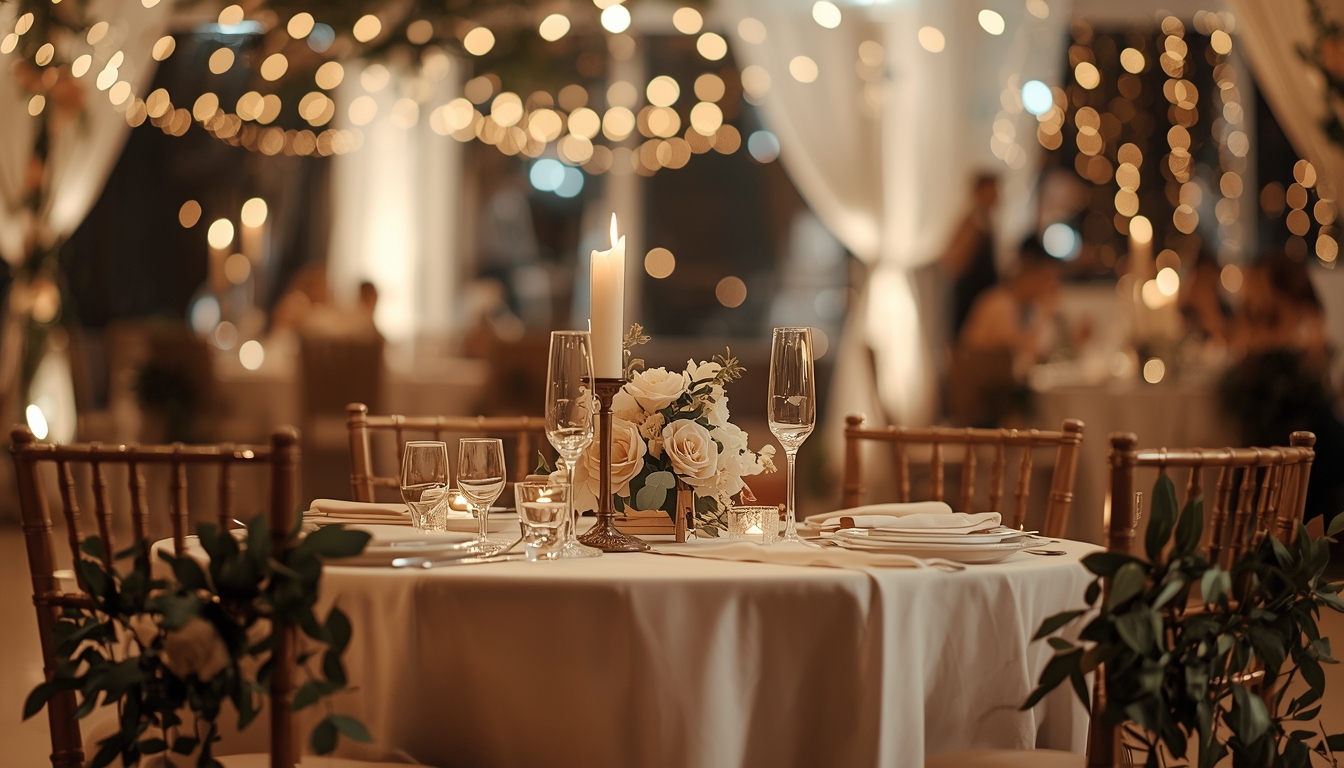
Because it's just for two, the table itself becomes part of the décor. A typical setup includes:
- Two place settings with full plates, glasses, and flatware
- A larger or more elaborate floral centerpiece than the guest tables
- Candles or candelabras
- A monogram or signage behind the table (optional)
- The couple's bouquet displayed on the table during dinner
- Two place cards (yes, even though it's obvious who sits where, the cards finish the look)
For place card formatting, our guide on how to write wedding place cards covers titles, names, and styling.
Common Mistakes to Avoid
- Adding extra seats. A sweetheart table is for two. Adding the maid of honor or the best man defeats the point. If you want them with you, use a head table instead.
- Placing it too far from the guests. A sweetheart table 30 feet from the nearest guest table feels isolating. Keep it close enough that guests can see and toast you easily.
- Forgetting to eat. Couples often spend the dinner round talking to guests at other tables and never eat. Ask the catering team to plate your food and keep it warm. The sweetheart table makes this easy because there are only two plates to track.
- Skipping the décor. The sweetheart table is photographed all night. A bare table for two looks underwhelming. Invest more in this table's centerpiece than any guest table.
Quick Reference
- The sweetheart table is for the newlyweds only
- Bride on the left (from guests' view), groom on the right, traditionally
- Place it at the front, facing the guests
- Decorate it more elaborately than guest tables, it's the visual focal point
- Wedding party sits at their own tables with friends and partners
- Plan for the couple to actually eat (caterer should plate your food)
If you're still building the rest of your seating plan, the sweetheart table is the easy part. The rest of the room is where it gets interesting. Our step-by-step guide to creating a wedding seating chart walks through the order of operations once you've decided where the two of you will sit. And MySeatPlan's drag-and-drop seating chart builder makes it easy to map the sweetheart table, the guest tables, and the rest of the room visually before you commit to it.
Plan your perfect event seating arrangement
MySeatPlan gives you everything you need to organize your big day — all in one place.
- Drag-and-drop seating chart
- Guest list with RSVP tracking
- Export seating charts as images & PDF
- Share your plan with others via shareable link
- Design your invitation card
- Guest photo & video uploads