What's the Difference Between a Save the Date and an Invitation?
 MySeatPlan
·
MySeatPlan
·
A save the date is an early heads-up sent 6 to 12 months before the wedding. An invitation is the formal request to attend, sent 6 to 8 weeks before with full details and an RSVP card. Here's how they're different and what each one needs to include.
Ready to create your own event seating chart?
Try our free drag-and-drop seating chart builder.
Get Started →A save the date is an early heads-up that lets guests know your wedding date so they can plan ahead. An invitation is the formal, detailed request to attend, sent closer to the wedding with the full information and an RSVP card. Save the dates go out 6 to 12 months before the wedding, invitations go out 6 to 8 weeks before. They're different cards with different jobs, and most weddings send both.
The Quick Answer
| Save the Date | Invitation | |
|---|---|---|
| Purpose | Reserve the date in guests' calendars | Formally invite guests, gather RSVPs |
| When sent | 6 to 12 months before | 6 to 8 weeks before |
| RSVP needed? | No | Yes |
| Format | Casual, often digital or photo card | Formal, usually printed suite |
| Includes venue? | City and state, not full venue | Full venue address |
| Includes time? | Date only, no specific time | Exact ceremony time |
| Skip it? | Sometimes (short engagements, all-local guests) | Almost never |
What a Save the Date Does
A save the date is essentially an early "block this date on your calendar" notice. It tells guests:
- You're getting married
- The date
- The general location (city and state, occasionally country)
- That a formal invitation will follow
That's it. No RSVP. No registry info. No venue details. The point is to give guests enough warning to plan ahead, especially if the wedding involves travel, falls on a holiday weekend, or competes with peak vacation seasons.
Save the dates work because they answer the question "should I keep this weekend free?" without committing the guest to anything yet. They have months to decide; you have a head start on attendance estimates.
What an Invitation Does
The invitation is the formal request to attend. It has a different job: it gives guests every detail they need to actually show up, and it asks them to confirm whether they will.
The invitation includes:
- The full names of the couple (and traditionally the hosts, if parents are paying)
- The exact date
- The ceremony start time
- The full venue name and address
- The reception location (if separate from the ceremony)
- Dress code (if you want one)
- An RSVP card with a clear deadline
- A details card with parking, transportation, accommodations, and a wedding website URL
The invitation is the keepsake piece. The save the date is the practical heads-up. They serve different purposes and use different formats accordingly.
The Two-Step Approach (Why You Send Both)
The save-the-date / invitation pairing works because guest planning happens in two phases:
Phase 1: Calendar reservation (6 to 12 months out)
The save the date arrives. Guests block the date in their calendar, request the day off if needed, mention it to their partner, and start making preliminary travel plans.
Phase 2: Commitment (6 to 8 weeks out)
The invitation arrives with full details. Guests confirm they're coming, RSVP with their meal choice, and finalize travel and accommodations.
Skipping the save the date means guests find out about your wedding 6 weeks before it happens, which often isn't enough time to rearrange travel, work, or family plans. Skipping the invitation means guests don't have the information they need to actually attend.
When You Can Skip the Save the Date
Save the dates aren't strictly required. A few situations where skipping is fine:
- Short engagements (under 4 months). Send invitations earlier instead, around 10 to 12 weeks before.
- Mostly local guests with no travel. If 95% of your guest list lives within 30 minutes of the venue, the planning runway is shorter and save the dates matter less.
- Tiny weddings (under 20 guests). If you're calling each guest personally to invite them, a separate save the date is overkill.
- Eloping or a courthouse plus dinner. Casual events don't usually use save the dates.
For everything else, including any wedding with significant travel or one falling on a busy weekend, send save the dates.
When You Should Definitely Send Both
- Destination weddings. Save the dates 9 to 12 months out, invitations 12 weeks out. Guests need maximum lead time for travel.
- Holiday-weekend weddings. Memorial Day, July 4th, Labor Day. Guests have competing commitments.
- Weddings with 30%+ out-of-town guests. Travel takes more planning than locals expect.
- Peak season weddings (May to October). Calendars fill up early.
- Weddings overlapping major sports events or industry conferences. If your wedding falls on Super Bowl Sunday or during a major industry conference your guests attend, give them maximum notice.
How Each One Looks
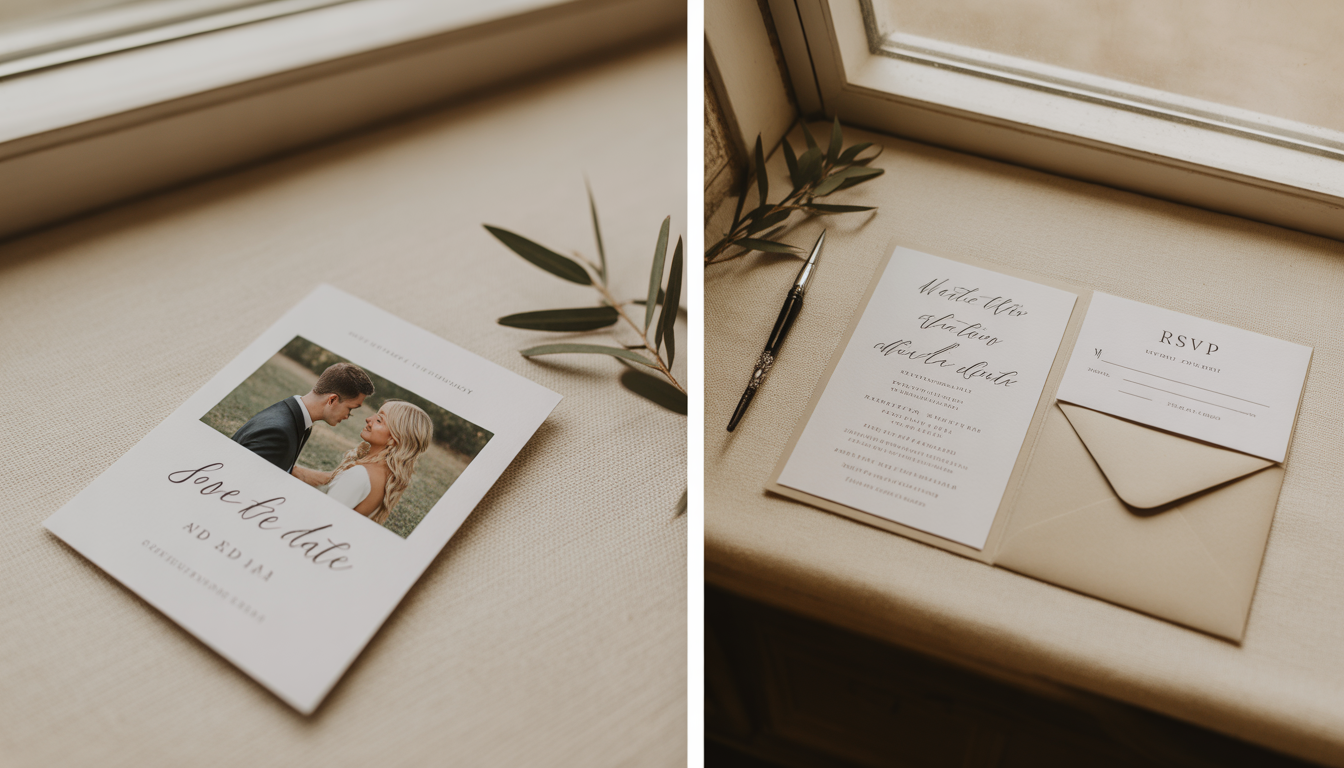
Save the date format
Save the dates are casual by design. Common formats:
- A photo postcard with the couple's engagement photo and the date
- A simple printed card with the names and date
- A digital design sent by email or text
- A magnet (popular for guests who want to stick it on the fridge as a reminder)
Tone is informal, sometimes even playful. The visual style usually matches the eventual invitation style, but doesn't have to.
Invitation format
Invitations are more formal. They typically come as a suite:
- Main invitation card
- RSVP card with a return envelope
- Details card with practical info
- Outer envelope addressed to the guest
- Optional inner envelope (traditional)
The visual style sets the tone for the wedding itself. Formal calligraphy and letterpress for traditional weddings, modern minimalist printing for casual ones, watercolor and florals for garden weddings, and so on.
Should They Match?
Save the dates and invitations don't have to match visually, but they often do. Most couples pick a stationery style early (color palette, typography, motif) and use it across both, plus the wedding website, programs, menu cards, and place cards. The continuity adds polish.
If you're working with a stationery designer, they'll typically design the entire suite at once for consistency. If you're using online services like Minted, Zola, or Vistaprint, pick a "collection" so all pieces share a design language.
Common Mistakes
- Sending save the dates to people you're not 100% sure you're inviting. A save the date is a soft commitment. Once it's sent, it's awkward to not follow up with an invitation. Only send to confirmed invitees.
- Putting too much info on the save the date. No RSVP, no registry, no full venue address. Keep it simple. The invitation handles details.
- Sending the save the date and invitation too close together. If you send save the dates 10 weeks out and invitations 8 weeks out, the save the date wasted everyone's time. Save the dates need a real lead, 6 to 12 months.
- Skipping save the dates and sending invitations late. If you skip the save the date, send invitations earlier (10 to 12 weeks). Otherwise guests have only 6 weeks to plan, and out-of-town RSVPs drop.
- Inconsistent guest names. The save the date should match the invitation. If a guest gets a save the date addressed to "Mr. and Mrs. Allen" and an invitation to "Mr. James Allen and Ms. Rachel Kim," it confuses them about whether both are still invited.
- No wedding website URL. Both pieces should point guests to your wedding website where they'll find updates, accommodations, and travel info.
The Wedding Website Connection
A wedding website is the third piece of the invitation puzzle, sitting between the save the date and the formal invitation. It holds:
- Travel and accommodation information
- The full schedule of weekend events
- Dress code and weather details
- The story of how you met
- Registry links
- FAQs about kids, plus ones, dietary needs
Both the save the date and the invitation should include the website URL. The website handles all the details that don't fit on a printed card, and it can be updated as plans evolve.
Quick Reference
- Save the date: early heads-up, 6 to 12 months before, no RSVP, casual format
- Invitation: formal request, 6 to 8 weeks before, includes RSVP, formal format
- Save the date: date and city only
- Invitation: full date, time, venue, RSVP, dress code, details
- Send both for any wedding with travel, holiday weekends, or peak season timing
- Skip the save the date for short engagements, all-local guest lists, or tiny weddings
- Both should point to your wedding website
- Don't send a save the date to anyone you're not 100% inviting
Save the dates and invitations work together as a two-step communication system: one reserves the date, the other delivers the details. Once invitations go out and RSVPs start coming back, the next major task is the seating chart. Our guide on how to create a wedding seating chart walks through the step-by-step process from final RSVPs to printed place cards. For the broader timing of every wedding decision, see our complete wedding planning timeline. And for help organizing the seating chart once your final headcount is locked, MySeatPlan's drag-and-drop seating chart builder handles the next step visually.
Plan your perfect event seating arrangement
MySeatPlan gives you everything you need to organize your big day — all in one place.
- Drag-and-drop seating chart
- Guest list with RSVP tracking
- Export seating charts as images & PDF
- Share your plan with others via shareable link
- Design your invitation card
- Guest photo & video uploads