Who Sits at the Head Table at a Wedding?
 MySeatPlan
·
MySeatPlan
·
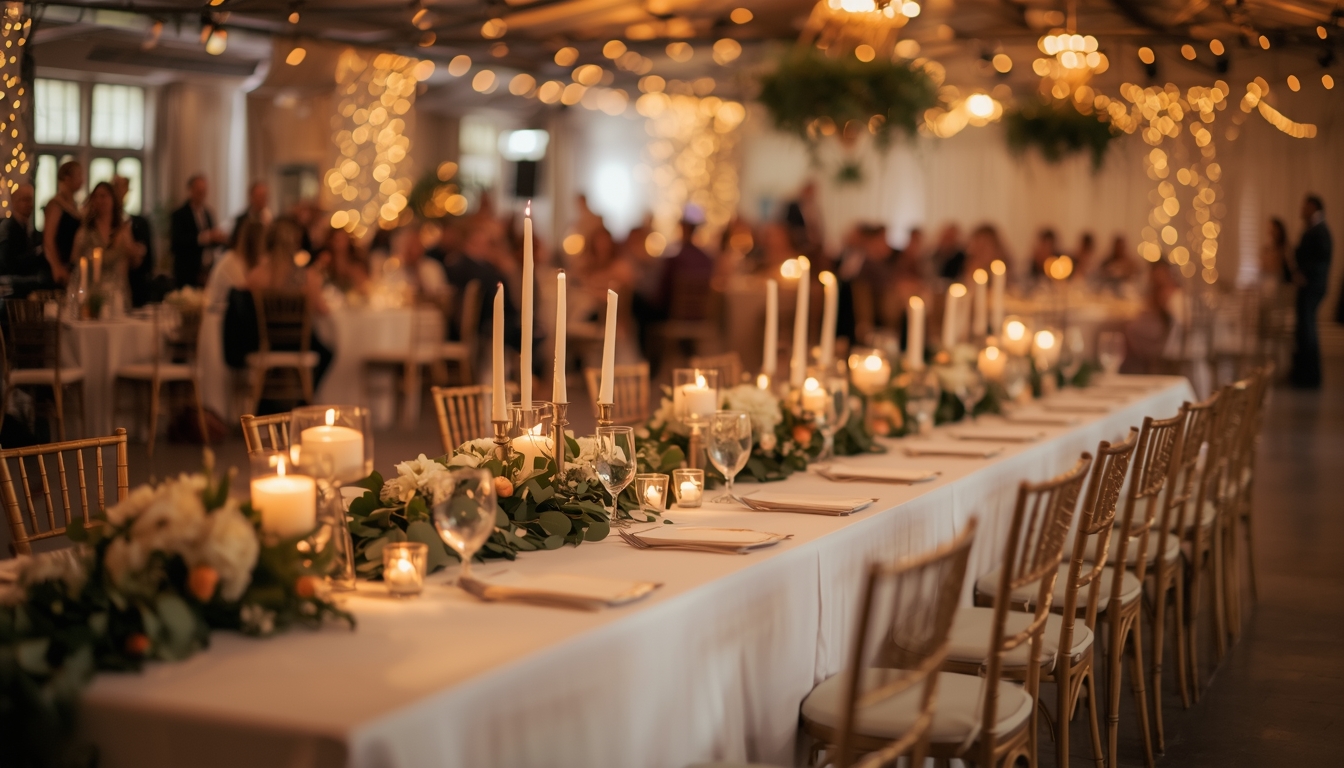
The head table seats the couple along with the wedding party, all on one side of a long table facing the guests. Here's the traditional seating order, modern variations, and where parents, plus-ones, and the officiant fit in.
Ready to create your own event seating chart?
Try our free drag-and-drop seating chart builder.
Get Started →The head table seats the couple plus the wedding party, traditionally on one side of a long table facing the guests. The bride sits to the right of the groom (from the couple's perspective), with the maid of honor next to the groom and the best man next to the bride. The rest of the bridesmaids and groomsmen alternate down the table, usually closest-to-furthest by relationship.
The Traditional Seating Order
Reading the table from the guests' view, left to right, the standard order is:
- Bridesmaid (furthest)
- Groomsman
- Bridesmaid
- Groomsman
- Maid of Honor
- Groom
- Bride
- Best Man
- Bridesmaid
- Groomsman
- Bridesmaid (furthest)
The pattern: couple in the dead center, maid of honor and best man immediately flanking, then alternating bridesmaid/groomsman outward. Everyone sits on one side, all facing the guests, like a panel. This is sometimes called the "king's table" arrangement.
The Quick Reference
| Seat | Who |
|---|---|
| Center, left of groom | Bride |
| Center, right of bride | Groom |
| Next to the bride | Best Man |
| Next to the groom | Maid of Honor |
| Outward from center | Alternating bridesmaids and groomsmen |
Note that the bride is on the groom's left from the couple's perspective, which means she's on the right from the guests' view. This mirrors the ceremony in Christian tradition.
Why the Head Table Looks This Way
The "all on one side, facing the guests" layout isn't accidental. It's designed to do three things:
- Make the wedding party visible. The head table is the visual anchor of the room. Guests want to see the people they came to celebrate.
- Frame photographs. Cameras work best when subjects are aligned, not facing each other across a table.
- Set a clear front of room. Toasts, the cake cutting, and the first dance all happen near the head table. A clear directional "front" anchors the program.
The trade-off is that the wedding party can't talk easily across the table. Conversations happen with the people on either side, not opposite. If a more conversational dynamic matters to you, a sweetheart table or round wedding-party tables work better.
Where Do the Plus-Ones Sit?
This is the biggest unanswered question about the head table, and it has two valid answers.
Option 1: Plus-ones don't sit at the head table
The classic approach. The wedding party sits at the head table without their partners. Plus-ones get a designated table near the head table (sometimes called the "wedding party plus-one table") with a few of the couple's close friends mixed in.
Pros: Keeps the head table's visual symmetry. The wedding party gets a focused experience together.
Cons: Plus-ones can feel like they were left out, especially if they don't know anyone else.
Option 2: Plus-ones sit at the head table
More modern, especially common when the wedding party has long-term partners or spouses. The seating order becomes pairs: bridesmaid + her partner, groomsman + his partner, alternating.
Pros: No one feels excluded. Conversations are easier.
Cons: The table doubles in length. Visual symmetry is harder.
Either choice is correct. Decide early so the table size and place cards reflect it.
Where Do Parents Sit?
Parents traditionally do not sit at the head table. They have their own "parents' table" placed close to the head table, typically including:
- Bride's parents
- Groom's parents
- Grandparents (if mobile and present)
- The officiant and their plus-one
- Sometimes a close family friend or godparent
This setup gives the parents their own moment of dignity (they're the hosts) without competing with the wedding party for attention. If parents are divorced, the parents' table can become two tables, one per side. Our guide on seating divorced parents at a wedding covers the etiquette in depth.
Where Does the Officiant Sit?
The officiant is traditionally seated at the parents' table or with close family. They are not at the head table. If the officiant is a close friend or family member who's also in the wedding party, the rules bend, but the default is "honored guest at the family table, not the wedding party panel."
Modern Variations
Couples increasingly skip the traditional head table entirely. The most common alternatives:
- Sweetheart table. Just the couple, alone at a small table. The wedding party sits at regular guest tables with their partners and friends. See who sits at the sweetheart table for the full breakdown.
- King's table. A long banquet table with the couple in the center and family-style seating on both sides, mixing the wedding party with parents, grandparents, and close friends.
- Round head table. A single round table seating 8 to 10, with the couple in the center facing the room. More conversational, less formal.
- No head table at all. The couple rotates between guest tables during the dinner courses. Works best for very small weddings (under 50 guests).
If you're weighing options, our head table vs. sweetheart table comparison walks through the trade-offs in detail.
Common Mistakes
- Putting the bride and groom at the ends. They sit in the center of the table, not at the heads. The center is the visual focal point.
- Mixing up the maid of honor and best man. Best man sits next to the bride. Maid of honor sits next to the groom. Easy to flip if you're not paying attention.
- Forgetting plus-ones until the last minute. Decide early whether they're at the head table or at a separate table. Late changes mean reprinting place cards.
- Placing the head table too close to the wall. The wedding party needs room to stand for toasts, the first dance, and photo moments. Leave 4 to 6 feet of clearance behind the table.
- Forgetting the officiant's seat. They have to eat somewhere. Plan for it at the parents' table.
Quick Reference
- Head table = couple + wedding party, all on one side facing the guests
- Bride and groom in the center, maid of honor next to the groom, best man next to the bride
- Bridesmaids and groomsmen alternate outward
- Parents sit at a separate parents' table, not the head table
- Officiant sits with the parents or close family
- Plus-ones either join the head table or get a designated nearby table, decide early
- Leave space behind the table for toasts and the first dance
Once you've decided who's at the head table, the rest of the seating chart is just guest placement. MySeatPlan's drag-and-drop seating chart builder lets you place the head table, parents' table, and guest tables visually so you can see how the room flows before locking it in. For the full order of operations once the head table is set, our step-by-step seating chart guide walks through every step from final RSVPs to printed place cards.
Plan your perfect event seating arrangement
MySeatPlan gives you everything you need to organize your big day — all in one place.
- Drag-and-drop seating chart
- Guest list with RSVP tracking
- Export seating charts as images & PDF
- Share your plan with others via shareable link
- Design your invitation card
- Guest photo & video uploads