Are Place Cards and Escort Cards the Same Thing?
 MySeatPlan
·
MySeatPlan
·
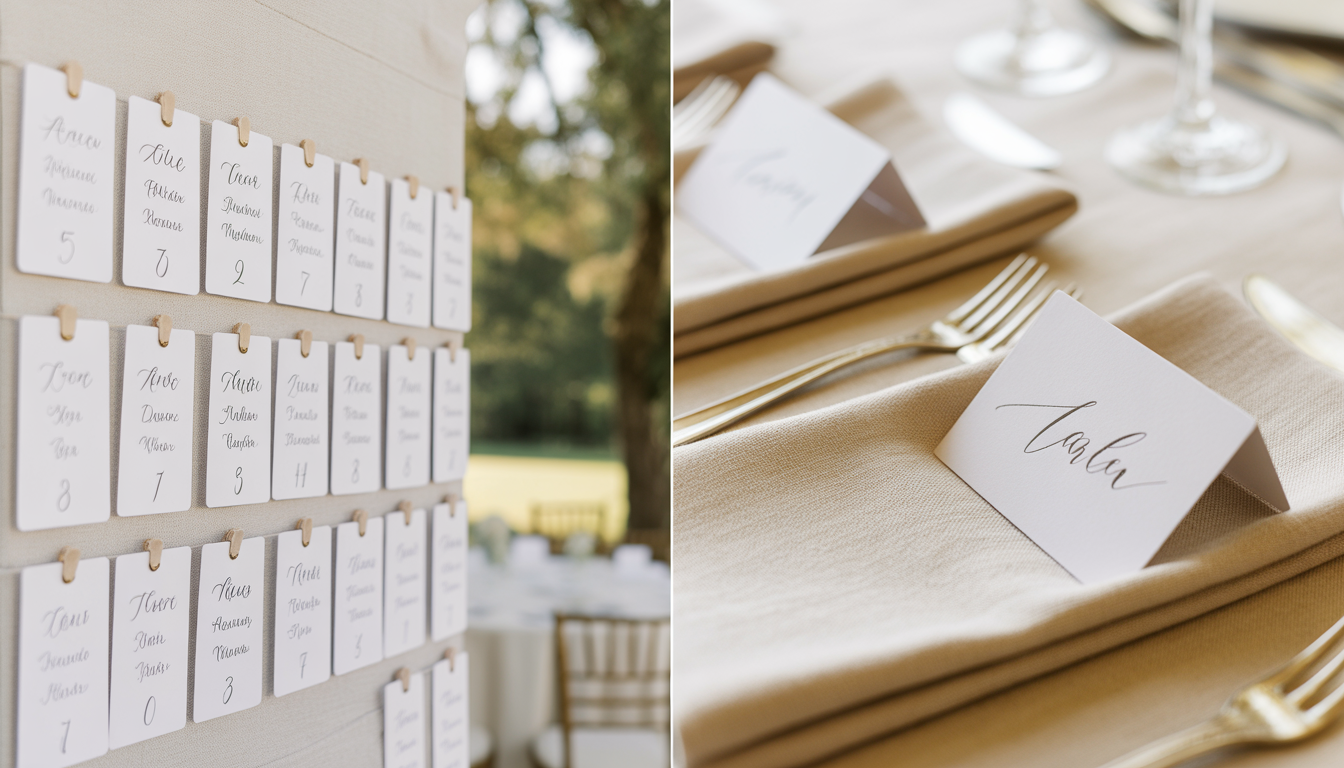
No, place cards and escort cards are not the same thing. Escort cards live at the entrance and tell guests which table to go to. Place cards sit at each chair and tell guests their specific seat. Here's how each one works and when you need both.
Ready to create your own event seating chart?
Try our free drag-and-drop seating chart builder.
Get Started →No, place cards and escort cards are not the same thing. Escort cards are picked up at the entrance and tell each guest which table to sit at. Place cards sit on the table at each individual seat and tell guests their specific chair within that table. Most weddings under 80 guests use one or the other. Larger weddings often use both: an escort card to find the table, and a place card to find the seat.
The Quick Answer
| Escort card | Place card | |
|---|---|---|
| Where it lives | At the entrance, on a display table | At each individual seat |
| What it tells guests | Which table to go to | Which chair to sit in |
| Arranged by | Alphabetical, by guest name | By table, in seating order |
| Picked up by guests | Yes, they take it to the table | No, it stays at the seat |
| Quantity | One per guest | One per guest |
The two cards do different jobs at different points in the night. Escort cards solve the "where am I sitting" question at the entrance. Place cards solve the "which chair is mine" question once the guest reaches their table.
What Escort Cards Are For
Escort cards live at a display near the reception entrance, alphabetized by guest name. Each card has the guest's name on the front and their table number (or table name) inside or below.
The flow:
- Guest enters the reception space.
- Walks past the escort card display.
- Finds their card alphabetically (it might say "Ms. Emily Parker, Table 4").
- Picks up the card and walks to Table 4.
- Sits anywhere at Table 4, or finds their place card if you also have those.
Escort cards are essential for weddings over 80 guests, because asking 80+ people to find themselves on a single posted seating chart at the entrance creates a 15-minute bottleneck. Each guest finding their own small card alphabetically is much faster.
What Place Cards Are For
Place cards sit on the dinner table itself, at each individual seat. Each card has one guest's name on it. The cards are arranged in the seating order you've already planned, so when guests reach their table, they walk around it until they see their name.
Place cards do three things:
- Confirm individual seats. Critical when you've thought carefully about who sits next to whom.
- Help the kitchen. If guests have selected meal options (chicken, fish, vegetarian), the catering team needs to know which plate goes to which seat. Place cards anchor that.
- Add a polished detail. Place cards are one of the small touches that make a reception table feel intentional rather than thrown together.
For deeper guidance on writing place cards (titles, formatting for couples, how to handle children), see our guide on how to write wedding place cards.
When to Use Just One vs. Both
The right combination depends on guest count and how much control you want over individual seats.
| Wedding size | What to use |
|---|---|
| Under 30 guests | Place cards only (or skip both if open seating) |
| 30 to 80 guests | Either escort cards or place cards |
| 80 to 150 guests | Both, escort cards at the entrance + place cards at each seat |
| 150+ guests | Both, escort cards essential to avoid bottlenecks |
| Plated dinner with multiple meal options | Place cards always (the kitchen needs them) |
What About a Single Seating Chart Sign?
Some weddings replace escort cards with a single large posted seating chart at the entrance. One sign, all the names, organized by table number. This works for under 80 guests, but breaks for larger weddings because too many people end up crowded in front of one sign at the same moment.
If you do use a seating chart sign, place it where it's easy to read from a step or two back, with names alphabetized by first or last name (not by table). Guests want to find their own name first, then learn the table number.
How They're Designed
The visual design follows the same rules for both, but the format differs.
Escort cards
- Small, typically 2 x 3.5 inches (similar to a business card)
- Tent-folded so they stand upright on the display table
- Guest's name on the front, table number on the front or just inside
- Often arranged alphabetically on a long display table, sometimes attached to a creative element (a photo wall, a corkboard, a fruit display)
Place cards
- Smaller, typically 2 x 3.5 inches or smaller
- Flat or tent-folded
- Guest's name only, no table number (the card is already at the table)
- Sometimes integrates with the menu card or napkin
You can use both elements at very formal weddings, or skip one to save money and time. Calligraphy is beautiful but adds significant cost. Printed cards from a stationer or done at home with a nice printer look just as polished for a fraction of the price.
The Order of Operations
The sequence matters. You can't write either card until the seating chart is done.
- Final RSVPs come in. Lock the guest list.
- Build the seating chart. Decide who sits at which table, and (if using place cards) which chair.
- Print or write escort cards. One per guest, with their table number.
- Print or write place cards. One per guest, no table number needed.
- Hand off to the day-of coordinator. They set up the escort card display and place the place cards on the tables before guests arrive.
Build the seating chart in MySeatPlan's drag-and-drop seating chart builder and you can export a list of all guest assignments, sorted alphabetically (for escort cards) or by table (for place cards), so the writing or printing step takes minutes instead of hours.
Common Mistakes
- Confusing the two and labeling them wrong. Escort cards have table numbers. Place cards don't. Mixing this up creates chaos at the entrance.
- Alphabetizing escort cards by table instead of by guest name. Guests don't know their table yet, so alphabetical by name is the only useful sort.
- Using a single seating chart for 150 guests. The bottleneck kills cocktail hour. Use escort cards for anything over 80.
- Forgetting place cards when meal options vary. If half the room ordered fish and half ordered chicken, place cards are the only way the kitchen tracks plates.
- Printing too early. RSVPs and seating change up to the week of the wedding. Print escort and place cards 7 to 10 days before, not 30 days before.
- No backups. Keep 5 to 10 blank cards and a matching pen on hand for last-minute additions or corrections.
Quick Reference
- Escort cards: at the entrance, alphabetical, tell guests their table
- Place cards: at each chair, by seating order, tell guests their specific seat
- Under 30 guests: place cards only, or skip both
- 30 to 80 guests: either escort cards or place cards
- 80+ guests: both, escort to find the table, place to find the seat
- Multiple plated meal options: place cards required (kitchen needs them)
- Print 7 to 10 days before the wedding, after RSVPs lock
- Always keep blank backup cards for last-minute changes
Escort cards and place cards are easy to confuse because they're both small, both have names, and both come from the same seating chart. Once you see them as solving two different problems (which table vs. which chair), the choice between them, and when to use both, becomes obvious. For the bigger picture, our guide on do you need assigned seats at a wedding covers when to use any kind of assignment in the first place, and our step-by-step seating chart guide walks through the full process from RSVP to printed cards.
Plan your perfect event seating arrangement
MySeatPlan gives you everything you need to organize your big day — all in one place.
- Drag-and-drop seating chart
- Guest list with RSVP tracking
- Export seating charts as images & PDF
- Share your plan with others via shareable link
- Design your invitation card
- Guest photo & video uploads