Chinese Wedding Banquet Seating Order: A Practical Guide
 MySeatPlan
·
MySeatPlan
·
Chinese wedding banquet seating is built around hierarchy, elders, and family honor. Here's a practical guide to the head table, the round tables, and the seating logic that shapes the entire night.
Ready to create your own event seating chart?
Try our free drag-and-drop seating chart builder.
Get Started →A Chinese wedding banquet (喜酒, xǐ jiǔ, literally "happy wine") is the central public celebration of a Chinese wedding. It's where families, friends, colleagues, and extended community gather to honor the couple, share auspicious dishes, and offer blessings. The seating chart at this banquet is not a logistical afterthought, it's a deliberate structure that reflects family hierarchy, respects elders, and signals the relationships between the two families coming together.
This guide walks through how Chinese wedding banquet seating typically works: the head table (主桌, zhǔ zhuō), the round tables, the family hierarchy, the toast round, and the symbolism that quietly shapes every decision. It's written for couples planning a Chinese wedding banquet and acknowledges upfront that customs vary significantly across mainland China, Taiwan, Hong Kong, Singapore, and the global Chinese diaspora.
A Note on Variance
"Chinese wedding banquet" is a broad term covering many regional traditions. Mainland Chinese, Taiwanese, Hong Kong / Cantonese, Singaporean, Malaysian Chinese, and overseas Chinese diaspora communities each have their own customs. Within each, family preferences and modern adaptations create further variance.
This guide covers patterns common to many modern Chinese wedding banquets, especially as they're held in restaurants and banquet halls in the US, Canada, the UK, Australia, and across Asia. Always defer to your family elders, your banquet coordinator, and your specific community's customs for the final decisions.
The Quick Overview
| Element | Where it sits |
|---|---|
| Head table (主桌) | Front of the room, facing the entrance, with the couple and most senior elders |
| Bride's family tables | One side of the room, near the head table |
| Groom's family tables | Opposite side of the room, near the head table |
| Friend tables | Middle of the room |
| Colleagues, extended guests | Outer ring |
Why Chinese Banquet Seating Is Different
A few structural differences from a Western reception are worth knowing upfront:
- Round tables of 10 are the standard. Almost every Chinese wedding banquet uses round tables seating 10, sometimes 12. The Chinese banquet is built around this format, not the long-table or mixed setups common at Western weddings.
- The head table is for elders, not just the couple. Unlike a sweetheart table or even a Western head table with the wedding party, the Chinese 主桌 prominently features the couple's parents, grandparents, and most senior relatives.
- Hierarchy is explicit. Senior elders are seated with explicit honor. Casual seating that ignores hierarchy is considered disrespectful.
- The toast round is structured. The couple visits each table during the banquet to toast guests, which means table layout has to accommodate this flow.
- Numbers carry meaning. Eight (八, bā) sounds like prosperity (发, fā) and is auspicious. Four (四, sì) sounds like death (死, sǐ) and is avoided. Table numbers and counts are often planned around these associations.
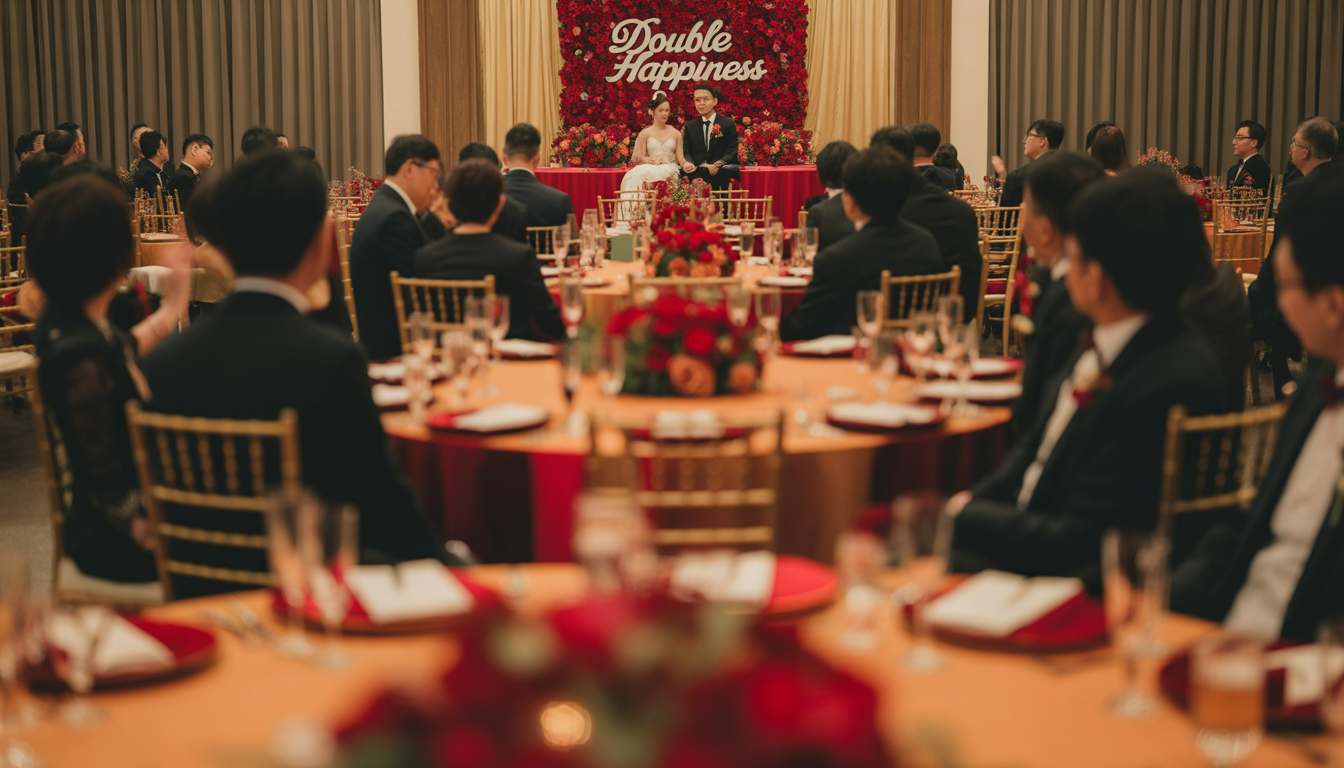
- The orientation matters. The most honored seat at any round table traditionally faces the entrance. The head table itself usually faces the room and the entrance, so the couple and elders can see all guests arriving.
The Head Table (主桌)
The head table is the most prestigious table in the room. It sits at the front, usually elevated on a small stage or simply positioned with a clear view of the entire room. A backdrop, often featuring the "double happiness" character (囍, shuāng xǐ) or the couple's names, sits behind it.
Who sits at the head table
The composition varies, but a typical 10-seat head table includes:
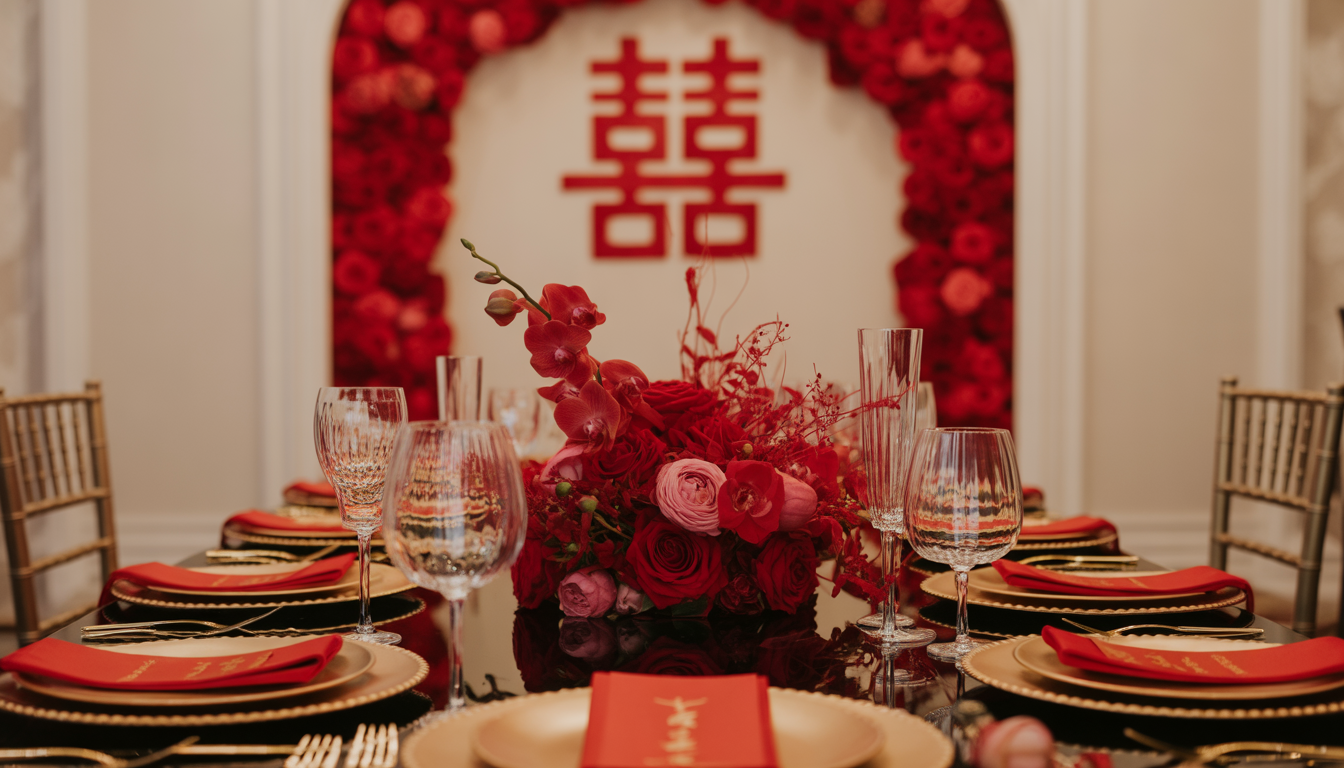
- The bride and groom (usually in the center, facing the room)
- The bride's parents
- The groom's parents
- The bride's grandparents (if attending and mobile)
- The groom's grandparents (if attending and mobile)
- Sometimes a senior aunt, uncle, or family elder of particular significance
If grandparents are not attending or there are complex family dynamics, the head table may include just the couple, both sets of parents, and a few senior aunts and uncles to fill the table.
Where the bride and groom sit at the head table
The couple typically sits at the center of the head table, side by side, facing the room. The specific left/right placement of the bride and groom varies by region, family preference, and modern adaptation. Some families follow traditional 男左女右 (man left, woman right) conventions; others mirror Western seating with the bride on the left from guests' view.
The simplest approach: ask your banquet coordinator or family elders for the local convention. If there's no strong preference, pick what works for your photographer's main angle and stay consistent across photos.
Where the parents sit
The bride's parents typically sit on the bride's side of the head table; the groom's parents on the groom's side. Grandparents from each family flank their respective parents.
If the head table seats only 8 or 10 and parents from both sides plus grandparents won't all fit, the most senior pair from each family takes priority, with the rest at a "VIP family table" immediately adjacent to the head table.
The Round Tables of Ten
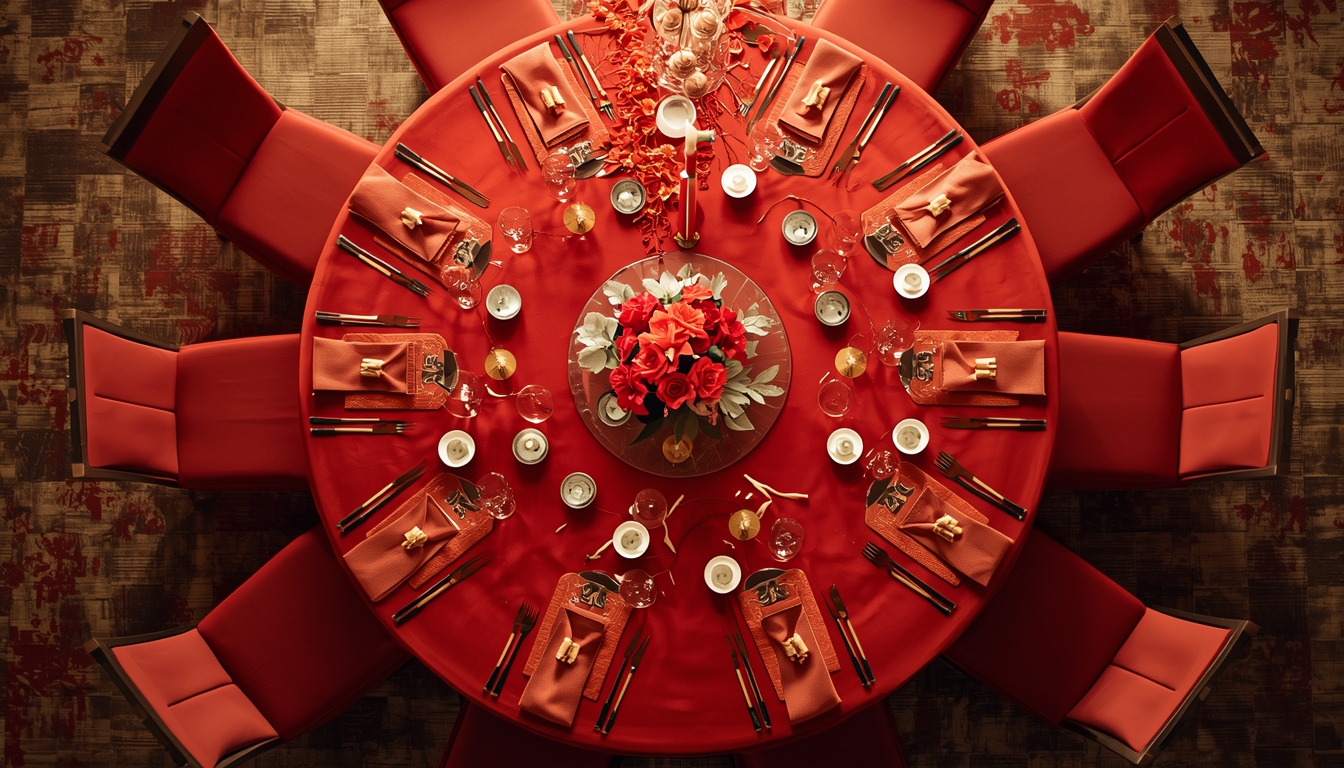
The rest of the room is filled with round tables, almost always seating 10 each (sometimes 12 in larger banquets, sometimes 8 in more intimate ones).
Why ten
Ten works for several reasons:
- It's the standard size at virtually every Chinese restaurant and banquet hall, so the venue's tables and table linens are sized for it.
- It allows balanced conversation, dishes circulate well on the lazy Susan, and each guest has reasonable elbow room.
- The traditional 8-course or 10-course menu portions are calibrated for 10 servings per dish.
For more on table sizing across wedding traditions, see our guide on how many guests per table.
The seat of honor at each round table
Even at non-head tables, traditional Chinese banquet etiquette honors the seat that faces the entrance of the room. This is the "head" of the round table for that group. At family tables, the most senior person at that table typically takes this seat. At friend tables, the highest-status guest (an elder, mentor, or close family figure) gets it.
This isn't strictly enforced at modern weddings, but families who care about tradition will arrange these seats deliberately. At minimum, ensure no senior elder is placed in a seat with their back to the entrance.
Family Hierarchy and Table Position
Tables radiate outward from the head table in approximate order of family closeness and seniority.
| Tier | Who sits here | Where |
|---|---|---|
| 1 | Head table (couple, parents, grandparents) | Front of the room, facing the entrance |
| 2 | Senior aunts, uncles, godparents, very close family friends | Adjacent to the head table |
| 3 | Parents' generation: aunts, uncles, family friends of the parents | Inner ring, near the head table |
| 4 | Cousins and their families | Mid-ring |
| 5 | Friends of the bride and groom | Mid to outer ring |
| 6 | Colleagues, distant relatives, acquaintances | Outer ring |
The bride's family typically occupies one side of the room, the groom's family the other, with mutual friends and the wedding party (if there is one) filling the middle. Cousins and friends in their 20s and 30s often have their own designated tables grouped together.
The Bride's Side and the Groom's Side
The split between sides is structural, not strict. Each side has its zone of tables, but mutual friends, the couple's shared social circle, and the wedding party fill the middle.
A practical note: don't force symmetry. If the bride's family has 12 tables of guests and the groom's family has 6, the seating chart should reflect that. Forcing equal halves leaves empty seats on the smaller side and crowded tables on the larger side.
The Tea Ceremony (Earlier in the Day)
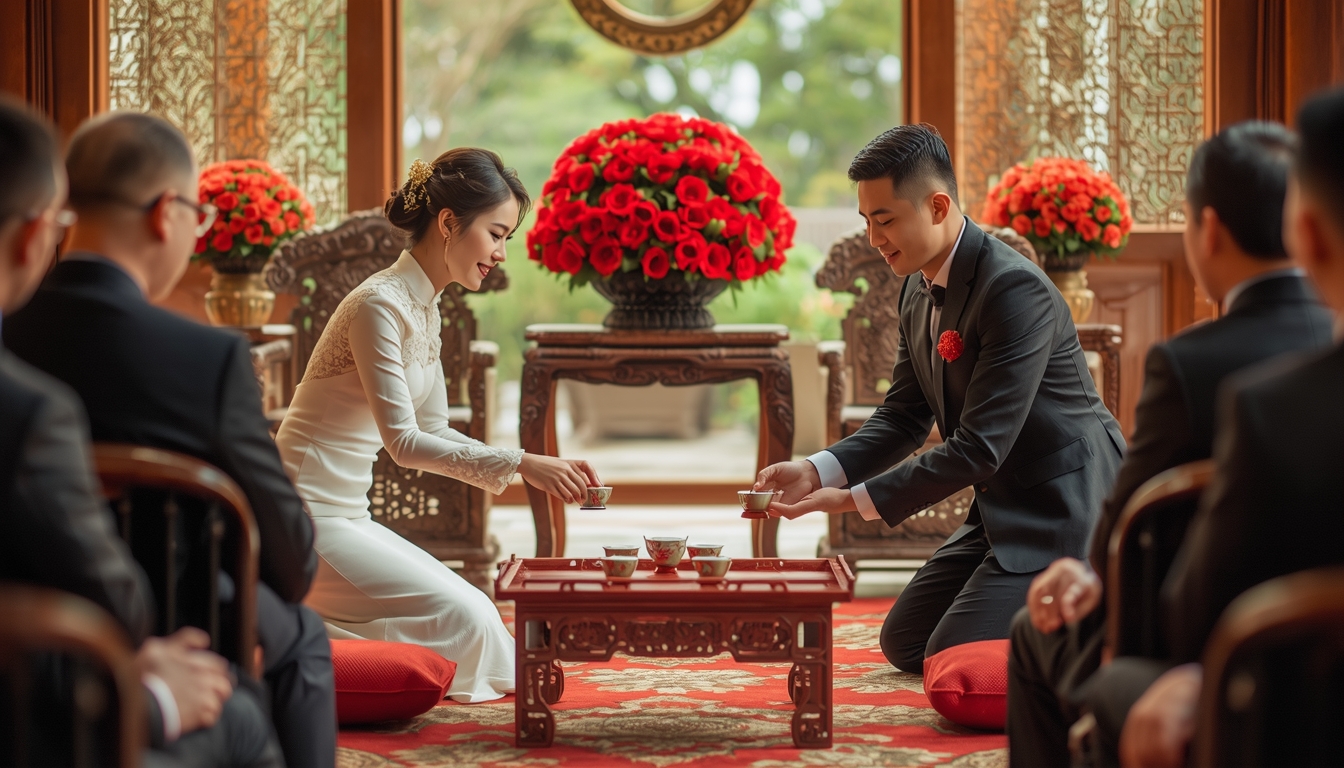
The tea ceremony (敬茶, jìng chá) is a traditional Chinese wedding ritual where the couple kneels or bows before family elders and offers them tea, receiving blessings and sometimes red envelopes (红包, hóngbāo) in return. This typically happens earlier on the wedding day, often at one or both family homes, well before the banquet.
Tea ceremony seating is different from the banquet:
- Family elders sit on chairs at the front of a small designated space
- The couple kneels, bows, or stands before each elder in turn, presenting tea
- The order moves from most senior to least: grandparents first, then parents, then aunts and uncles by age
The tea ceremony itself doesn't require a seating chart, but the order in which elders receive tea is important and worth confirming with both families before the day.
The Toast Round (敬酒)
Midway through the banquet (often after the third or fourth course), the couple and their parents typically begin the toast round. They visit each table in turn, raise a toast, and thank guests for attending.
This affects seating logistics in two ways:
- The flow. Tables should be arranged so the couple can walk between them without obstacles. Plan a clear path that loops the room.
- The order. The toast round usually starts with the most prestigious tables (head table area) and works outward. Tables should be numbered in this loop order so the venue staff can support the flow.
The bride often changes into a different gown (sometimes two or three over the course of the banquet) between the toast round and the rest of the meal. Plan time for this in the schedule.
Numbers and Symbolism
Numbers carry strong meaning in Chinese culture, and they affect wedding decisions including the seating chart.
- Eight (八, bā): auspicious, sounds like 发 (fā, prosperity). Tables of 8 are considered lucky. Eight courses, eight tables, eight specific dishes are all common.
- Nine (九, jiǔ): sounds like 久 (jiǔ, long-lasting), associated with longevity and lasting love.
- Six (六, liù): sounds like 流 (liú, flowing) or 顺 (shùn, smooth), associated with smooth progress.
- Four (四, sì): avoided, sounds like 死 (sǐ, death). Couples often skip table number 4 entirely, jumping from table 3 to table 5. Some banquet halls do this by default.
- Total guest count: auspicious totals (containing 8 or 9, avoiding 4) are sometimes planned around. This is more flexible than the table-numbering rule.
Most modern banquet halls handle the table-numbering convention automatically. Confirm with yours that table 4 is either skipped or appropriately handled.
The Backdrop, Stage, and Couple's Visibility
The head table backdrop is the visual anchor of the entire banquet. It typically features:
- The "double happiness" (囍) character, the most iconic Chinese wedding symbol
- Red and gold floral arrangements
- Sometimes the couple's names or wedding date in elegant typography
- Sometimes a small platform or stage so the head table is elevated above the floor
This backdrop becomes the photo-op location for the toast round, family photos, and the couple's portraits with each table's guests during the visit.
Special Considerations
Multiple banquets
Some families host two banquets, one in the bride's hometown and one in the groom's, especially when families live in different cities or countries. Each banquet has its own seating chart, with the host family taking the lead at the head table for that event.
Western-style elements
Many modern Chinese weddings, especially overseas, blend Chinese banquet traditions with Western reception elements (a wedding cake, a first dance, Western-style toasts in addition to the Chinese toast round). The seating chart still follows the Chinese banquet structure, with Western touches layered on.
Vegetarian and dietary considerations
Chinese banquet menus are typically extensive (8 to 12 dishes), and most include both meat and seafood. Confirm with your venue if any guests need vegetarian, halal, kosher, or allergen-aware options. Place these guests near a clear path for the kitchen to deliver custom plates.
Cousins and friends in their 20s
Younger family members and the couple's friend groups often want to sit together rather than scattered among parents' generation tables. Designate a few tables specifically for this age group, and let them fill those tables with their own preferred groupings.
Common Mistakes
- Treating the head table like a Western sweetheart table. The head table is for elders too. Don't isolate the couple alone at the front.
- Using table number 4. Either skip it entirely, replace it with 3A, or confirm with the venue that it's been removed from the rotation.
- Forcing equal sides. The bride's and groom's family guest counts often differ significantly. Reflect that in the table count, don't force symmetry.
- Forgetting elders' mobility. The most honored seats are at the front, but elders need accessible paths. Don't seat a 90-year-old grandparent at a head table they can't reach without navigating crowded tables.
- Skipping the toast round path planning. Tables packed too tightly leave no room for the couple to walk between them during 敬酒.
- Not numbering tables in toast-round order. If table numbering is random, the couple's path becomes inefficient and venue staff can't anticipate the flow.
- Underestimating the venue size. Chinese banquets often have 200 to 600+ guests. Many Western venues can't accommodate this, and you'll need a Chinese-specific banquet hall or large hotel ballroom.
- Forgetting the kids. Larger Chinese weddings have many children attending. A dedicated kids' table can work well; our atomic guide on should kids have their own table at a wedding covers the trade-offs.
- Not consulting both sets of parents. Chinese seating decisions are family decisions. Run the chart by both sets of parents (and if possible, grandparents) before locking it.
Working with the Banquet Hall
Most Chinese banquet halls and Chinese-cuisine wedding venues are deeply familiar with the standard layouts and will support the conventions described above. A few questions to confirm:
- Can the venue position the head table at the front with a backdrop?
- What's the maximum table count and capacity? (Critical for Chinese banquets, which often hit 50+ tables for large weddings)
- Does the venue automatically skip table number 4, or do you need to request it?
- Are lazy Susans included on each round table? (Standard at Chinese banquet halls; not standard elsewhere)
- Can the kitchen handle custom dietary needs at specific tables?
- What's the timing for the toast round, and how does the venue coordinate it?
Building the Chart at Scale
For a 300+ guest banquet across 30 to 60 tables, a spreadsheet is not a real seating plan. The hierarchy zones, the bride's and groom's side splits, the senior elder placements, the cousin clusters, and the inevitable late additions all need a visual layout.
MySeatPlan's drag-and-drop seating chart builder handles large Chinese banquets cleanly. You can lay out the head table, the family hierarchy zones, and the friend and colleague tables visually, then move guests between tables in seconds as the guest list shifts. The tool handles tables of any size and any count, so it scales from intimate 100-guest banquets to 600+ guest celebrations.
For the broader seating chart workflow, our step-by-step seating chart guide covers the order of operations from final guest list to printed table numbers. And for general seating principles that translate across most cultures, see our wedding seating chart etiquette guide.
Quick Reference: Chinese Banquet Seating Checklist
- Head table at the front with the couple, parents, and senior elders
- Backdrop with double happiness character or couple's names
- Head table seats 8 to 12, depending on grandparents and elder attendance
- Round tables of 10 throughout the rest of the room
- Table 4 skipped or renumbered
- Bride's side and groom's side zones, with shared friends in the middle
- Most honored seat at each round table faces the entrance
- Cousins and friend tables grouped in age clusters
- Clear walking path between tables for the toast round
- Tables numbered in toast-round order
- Final chart reviewed with both sets of parents (and grandparents) before printing
A Chinese wedding banquet seating chart, done well, makes the entire event feel intentional. The hierarchy is honored, the families are visibly respected, the toast round flows naturally, and every guest knows their place is a place of welcome. Plan it deliberately, defer to elders where their guidance matters, and use tools that scale with the guest count, because spreadsheet seating charts at this scale will not survive the week before the wedding.
Frequently asked questions
-
The head table (主桌) is reserved for the couple and the most senior family members, usually both sets of parents and grandparents. It sits at the front of the room facing the entrance, and it’s considered the most prestigious placement at the banquet.
Plan your perfect event seating arrangement
MySeatPlan gives you everything you need to organize your big day — all in one place.
- Drag-and-drop seating chart
- Guest list with RSVP tracking
- Export seating charts as images & PDF
- Share your plan with others via shareable link
- Design your invitation card
- Guest photo & video uploads